Skip to content

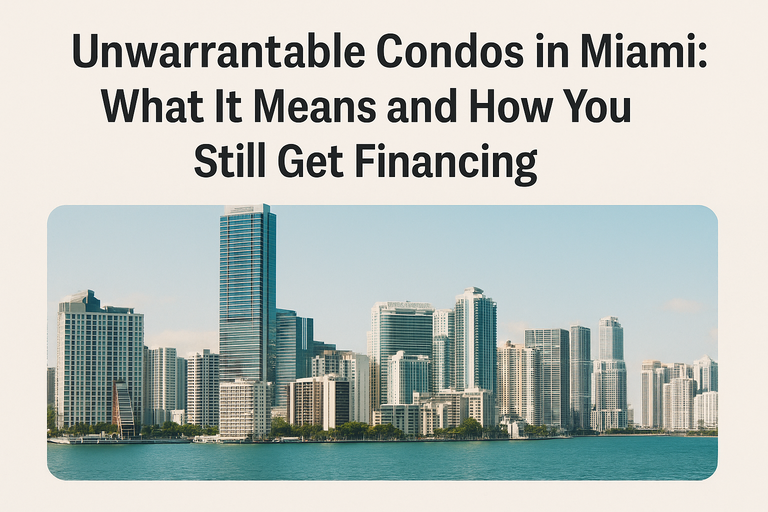
In Miami, a condo can be “perfect” and still be unwarrantable—meaning it doesn’t meet Fannie Mae/Freddie Mac condo project eligibility for standard conventional financing. That doesn’t automatically kill the deal. It just changes your financing path, your down payment, and your timeline.
Here’s what makes a condo unwarrantable, how to find out early, and what loans still work.
What “unwarrantable” actually means
A condo is generally considered warrantable if it meets agency project standards, allowing it to be sold to Fannie/Freddie. If it fails those standards, many conventional lenders can’t (or won’t) finance it as a normal conforming condo loan.
Common deal-killers include:
- Single-entity ownership concentration (one investor/entity owns too many units). Fannie’s Selling Guide spells out thresholds (e.g., 5–20 unit projects: max 2 units; 21+ unit projects: max 20%).
- Active litigation involving the condo association/project. Freddie lists condo projects in litigation as ineligible.
- Project ineligibility factors (nonstandard ownership, timeshare/segmented ownership, etc.).
- Financial weakness: inadequate reserves, high delinquency, budget problems (often shows up during condo questionnaire review). (This is a frequent practical trigger even when not publicly visible.)
Miami makes this worse because condos are everywhere, HOAs vary wildly in documentation quality, and “special assessment / repair / litigation” headlines are common conversation points.
How you find out BEFORE you waste weeks
Don’t rely on the listing agent saying “it’s fine.” Get proof.
1) Ask for the condo questionnaire early (Form 1076 is commonly used)
This collects the data underwriting needs (occupancy, litigation, reserves, insurance, delinquency, etc.).
2) Get the HOA documents immediately
You want budget, reserves, insurance declarations, and recent meeting minutes (minutes reveal pending litigation/special assessments long before people admit it).
Related reading you already have on-site:
Financing options that still work (and what changes)
Option A: Portfolio condo loan (the most common solution)
“Portfolio” means the lender keeps the loan instead of selling it to Fannie/Freddie. Many banks/credit unions and specialty lenders use portfolio programs for non-warrantable condos. (gulfbank.com)
Typical trade-offs:
- Higher rate than standard conventional
- Bigger down payment (often 10–25%+, sometimes more)
- More reserves required
- More documentation and underwriting scrutiny
Option B: Jumbo (sometimes)
If the loan amount is jumbo, you’re already outside standard conforming limits, and some jumbo lenders will do unwarrantable condos via portfolio/jumbo channels. Expect similar trade-offs: higher down, more reserves, tighter review.
Option C: FHA condo financing (only if the project is FHA-approved)
With FHA, it’s not just you—the condo project must be eligible/approved through FHA’s condo approval process. HUD’s documentation list makes it clear it’s a project-level review with specific required docs. (hud.gov)
So FHA can be a path if the building is approved (or can be approved), but it’s not a quick fix.
Option D: Cash (or heavy down payment)
Not glamorous, but it’s reality: buyers sometimes go cash, then refinance later if/when the project becomes eligible—but don’t assume it will.
When it’s still a bad idea (even if you can finance it)
Be honest with yourself. Financing is only half the risk.
You should be cautious if:
- There’s active litigation (resale and future financing can get worse, not better).
- The HOA is financially shaky or reserves are thin (expect dues increases and assessments).
- One entity owns a huge chunk of the building (market manipulation risk + financing limits).
If you’re buying as an investment, your exit matters: an unwarrantable condo has a smaller buyer pool later.
How to negotiate when a condo is unwarrantable
Use the financing pain as leverage:
- Ask the seller for price reduction (best long-term)
- Or seller concession to offset closing costs/rate buydown
- Shorten your inspection window only if you already have condo docs in hand
- Make sure your contract allows cancellation if HOA docs reveal disqualifying issues
And before you commit, force clarity with lender questions:
Bottom line
An unwarrantable condo in Miami doesn’t mean “no financing.” It means “no easy financing.” The winning move is to identify the issue early, pick the right lender/program (often portfolio), and negotiate like the buyer pool is smaller—because it is.