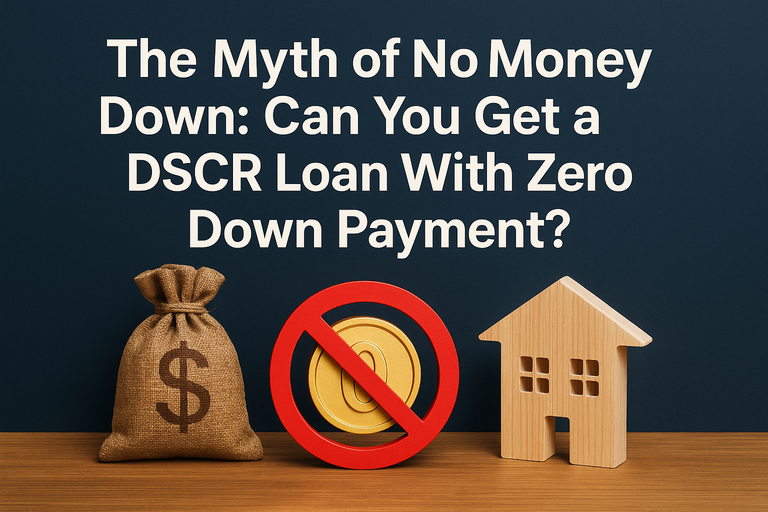
Real estate investors constantly search for creative financing strategies that minimize upfront capital requirements and maximize portfolio leverage. Given DSCR loans’ flexibility and streamlined qualification process, many investors wonder: can you get a DSCR loan with no money down? The straightforward answer disappoints many aspiring investors—no, zero-down DSCR loans don’t exist in the traditional sense. However, understanding why this limitation exists, exploring alternative strategies for minimizing initial capital, and learning creative financing techniques can help Florida investors build portfolios even with limited cash reserves.
Can You Get a DSCR Loan With No Down Payment? The Direct Answer
No—can you get a DSCR loan with no down payment is answered with a definitive no across virtually all DSCR loan programs. Investment property financing, whether conventional or non-QM like DSCR loans, requires substantial borrower equity. Most DSCR programs require minimum 20-25% down payments, with some accepting as low as 15% for exceptional borrowers and properties.
This down payment requirement reflects fundamental lending principles: lenders need borrowers to have “skin in the game” to reduce default risk. Investment properties carry higher risk than owner-occupied homes because owners are more likely to walk away from rental properties during financial hardship than their primary residences. Down payments create a financial buffer protecting lenders against market fluctuations and providing borrowers with immediate equity stakes.
Why DSCR Loans Require Down Payments
Risk Mitigation: Down payments protect lenders if property values decline. If a $400,000 property drops 20% to $320,000, a borrower with 25% equity ($100,000) still has stake in the property, while a zero-down borrower would be significantly underwater.
Borrower Commitment: Substantial down payments demonstrate financial discipline and commitment, indicating the investor has successfully saved capital and is serious about the investment.
Secondary Market Requirements: Many DSCR lenders sell loans to secondary market investors who mandate minimum LTV ratios (typically 75-80% maximum loan-to-value).
Default Statistics: Historical data shows zero-down investment property loans have dramatically higher default rates than those with significant equity.
Program Economics: DSCR loans already carry higher rates than conventional loans due to reduced documentation. Eliminating down payments would price these loans uncompetitively.
Minimum Down Payment Requirements Across DSCR Programs
Understanding can you get a DSCR loan with no money down requires knowing actual minimum requirements:
Standard Programs: 20-25% down payment minimum for most borrowers with good credit (680-700+) and properties achieving 1.25+ DSCR ratios.
Aggressive Programs: Some lenders offer 15-20% down for exceptional scenarios (740+ credit, 1.5+ DSCR, significant reserves).
Compensating Factor Programs: 25-30% down may be required for borrowers with lower credit (660-680), marginal DSCR ratios (1.0-1.15), or challenging properties.
High-Risk Programs: 30-40% down for credit-challenged borrowers, properties with low DSCR ratios (0.75-0.99), or unique property types.
Florida Reality Check: Coastal properties requiring flood insurance often need 25-30% down to maintain qualifying DSCR ratios after factoring insurance costs into debt service calculations.
Creative Strategies for Minimizing Initial Capital
While can you get a DSCR loan with no down payment has a negative answer, several legitimate strategies reduce upfront capital requirements:
Strategy 1: Cross-Collateralization
Some portfolio lenders allow using equity in existing owned properties as collateral for new purchases, reducing cash down payment requirements.
Example: You own a free-and-clear Florida property worth $200,000. A portfolio lender might accept this as collateral, allowing you to purchase a $300,000 investment property with minimal cash down, securing both properties with blanket mortgages.
Limitations: Few DSCR lenders offer this option; typically available through local banks and portfolio lenders maintaining loans on their books.
Strategy 2: Seller Financing Combined with DSCR
In motivated seller situations, structure deals where sellers provide secondary financing covering part of the down payment.
Example: $400,000 property requiring 25% down ($100,000)
- DSCR loan: $300,000 (75% LTV)
- Seller carries: $50,000 second mortgage
- Cash down: $50,000 (effectively 12.5% cash down)
Critical Requirement: Most DSCR lenders prohibit seller financing or require it to be subordinate with strict terms. This strategy works only with lender approval and willing sellers—rare in competitive Florida markets.
Strategy 3: Partnership Capital
Partner with investors who provide down payment capital in exchange for equity ownership, reducing your personal cash requirements.
Example: You identify a Jacksonville rental property but lack full down payment capital. A partner contributes $75,000 for 50% ownership, you contribute $25,000, and together you secure DSCR financing for the remaining $300,000.
Consideration: Partners expect returns on their capital, reducing your long-term profitability but enabling portfolio entry with limited funds.
Strategy 4: HELOC for Down Payment
Borrow against equity in your primary residence or other owned properties using a Home Equity Line of Credit (HELOC) to fund DSCR loan down payments.
Example: Your primary residence has $150,000 available equity. Draw $80,000 from your HELOC to fund the down payment on a $320,000 Florida investment property.
Advantages:
- Accesses existing equity without selling properties
- HELOC interest may be tax-deductible
- Enables portfolio expansion with less liquid capital
Risks:
- Increases overall leverage and monthly obligations
- Places primary residence at risk if investment underperforms
- Creates two mortgage payments on the investment property (DSCR loan + HELOC repayment)
Strategy 5: 1031 Exchange
While not technically “no money down,” 1031 exchanges allow selling existing investment properties and rolling equity into new purchases, effectively funding down payments with appreciated property gains rather than new capital.
Example: Sell a Miami condo purchased years ago for $300,000, now worth $450,000. Through 1031 exchange, roll the entire $450,000 into down payments on multiple Florida properties financed with DSCR loans.
Advantage: Tax-deferred growth funds portfolio expansion without capital gains taxes or fresh capital injection.
Strategy 6: Portfolio Seasoning and Cash-Out Refinancing
Purchase properties using traditional financing or cash, wait 6-12 months for “seasoning,” then execute DSCR cash-out refinances pulling equity to fund subsequent property down payments.
Example Timeline:
- Year 1: Purchase Property A for $300,000 with conventional loan (20% down = $60,000)
- Year 2: Property appreciates to $340,000; execute DSCR cash-out refi at 75% LTV ($255,000 loan)
- Year 2: Extract $15,000 cash (plus original $60,000 equity less closing costs) to fund Property B down payment
Strategy: This creates a self-funding portfolio expansion system, though requiring initial capital and patience.
Why “No Money Down” Isn’t Always Desirable
Even if can you get a DSCR loan with no money down were possible, investors should question whether zero-down financing serves their interests:
Negative Cash Flow Risk: Without equity buffer, higher loan amounts create larger monthly payments, increasing negative cash flow risk if rental income disappoints.
Limited Equity Protection: Market downturns immediately create underwater positions, eliminating refinancing or sale options.
Higher Interest Rates: Zero-down loans (if available) would carry premium rates 2-3% higher than standard DSCR loans, dramatically impacting long-term profitability.
Foreclosure Risk: Without equity stakes, investors more easily walk away from underperforming properties, creating personal credit damage and financial losses.
Reduced Property Selection: Zero-down financing would face stricter property criteria, limiting investment options to only the strongest cash-flowing properties.
Building Capital for DSCR Down Payments
For investors currently unable to meet 20-25% down payment requirements, focus on capital-building strategies:
House Hacking: Purchase a multi-family property (duplex, triplex, quadplex) as your primary residence with FHA financing (3.5% down), live in one unit while renting others. Build equity, then convert to DSCR-financed investment property while moving to your next house-hack.
Forced Appreciation: Purchase distressed properties with cash or hard money loans, renovate to increase value and rental income, then refinance with DSCR loans extracting capital.
Strategic Savings: Aggressively save from W-2 or business income, targeting 25-30% of target property prices to fund down payments and reserves.
Side Income Allocation: Direct all side hustle, freelance, or business income exclusively to investment property down payment savings.
Credit Optimization: Build credit scores to 740+ to access programs accepting lower down payments (15-20% with exceptional credit).
The Florida Investor’s Reality
Can you get a DSCR loan with no down payment? No—but Florida’s robust rental markets make saving 20-25% down payments worthwhile investments. Consider:
Strong Cash Flow Markets: Jacksonville, Tampa, and emerging neighborhoods offer properties where 25% down payments produce strong cash flow, recouping initial investments through monthly income.
Appreciation Potential: Florida’s population growth and limited land availability create appreciation opportunities, building equity that funds future down payments through refinancing or sales.
Portfolio Velocity: Once you purchase your first DSCR-financed property, cash flow and appreciation fund subsequent down payments, creating compounding portfolio growth.
Affordable Entry Points: Unlike high-cost markets, Florida offers investment properties starting around $150,000-$200,000, making 25% down payments ($37,500-$50,000) achievable for disciplined savers.
The Bottom Line on Zero-Down DSCR Loans
While can you get a DSCR loan with no money down receives a negative answer, this limitation protects investors from excessive leverage and financial risk. The 20-25% down payment requirement, though substantial, remains lower than many commercial loan programs (typically 30-40% down) and provides crucial equity buffers.
Smart Florida investors focus not on eliminating down payments but on strategic capital deployment—using creative financing techniques, partnerships, and portfolio strategies to maximize returns while meeting lender requirements. The goal isn’t avoiding down payments but building sustainable wealth through properly financed, cash-flowing investment properties.
Ready to explore DSCR financing with realistic down payment strategies for Florida investment properties? Connect with mortgage professionals who can evaluate your capital position, recommend optimal down payment levels based on your properties and goals, and structure financing that balances leverage with long-term portfolio stability.