Skip to content

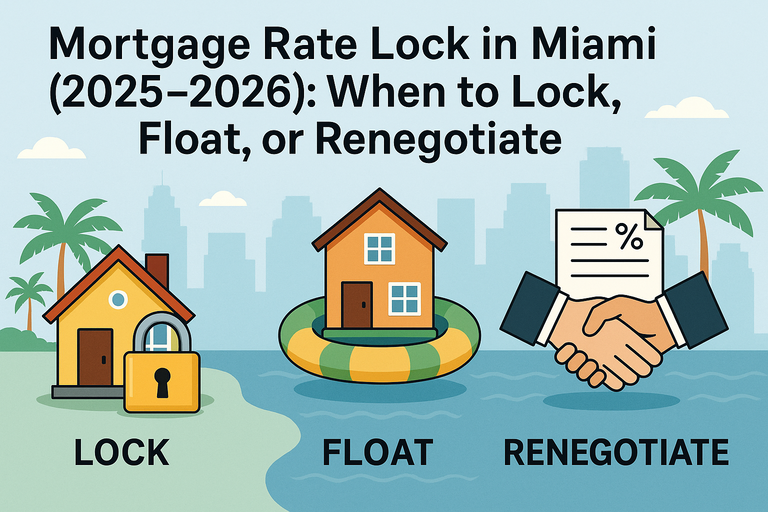
If you’re buying in Miami, a rate lock isn’t a “nice-to-have.” It’s a risk management decision that can save (or cost) you thousands. Most buyers get this wrong by treating it like a guess about the Fed. Don’t. Treat it like protecting your budget and your closing date.
Here’s how to decide when to lock, float, or renegotiate your mortgage rate in 2025–2026.
What a rate lock actually is (and what it isn’t)
A rate lock is the lender/broker agreeing to hold your interest rate (and sometimes points/fees) for a set period—often 15, 30, 45, or 60 days—while your loan closes.
It is not a promise that rates won’t move. Rates will move. The lock protects you from them moving against you.
When you should LOCK (most people should)
Lock when any of these are true:
1) You have a hard closing date (and Miami deals slip)
Miami closings get delayed—condo docs, insurance binders, appraisals, HOA approvals, title issues. If you’re inside ~30–45 days of closing and you’re already under contract, floating is basically gambling with your payment.
2) You’re near your maximum monthly payment
If a small increase breaks affordability, lock. Period. Buyers love to say, “I’ll just qualify anyway.” Underwriting doesn’t care about your optimism.
3) You’re using a program sensitive to pricing hits
Jumbo, condo-heavy scenarios, and any file with tighter DTI margins can get ugly fast if rates jump even slightly.
When you should FLOAT (rare, but valid)
Floating can make sense, but only if your risk is controlled.
Float if ALL of these are true:
- You’re more than 45–60 days from closing (or you’re not under contract yet)
- You can tolerate a payment increase without killing the deal
- You have a clear trigger to lock (example: “If rates rise by X or pricing worsens by Y points, lock immediately”)
Floating without rules is just hoping.
When you should renegotiate (a.k.a. “float down”)
Renegotiating happens when market rates improve after you lock. Here’s the blunt truth: not every lender offers meaningful float-downs, and even when they do, it’s usually restricted.
You have leverage to renegotiate if:
- Rates improved enough to matter (think: not tiny noise—real pricing improvement)
- You have time before closing (not the day before docs go out)
- Your lender has a written policy (or you’re ready to switch)
Ways it’s typically done:
- Float-down policy: lender adjusts rate/price if market improves beyond a threshold.
- Re-lock: cancel/reissue lock (may involve cost or rules).
- Lender credit/points adjustment: rate stays similar, fees change.
- Switch lenders: the nuclear option, but sometimes the best.
If you’re not willing to walk, your “renegotiation” is just asking nicely.
The Miami-specific trap: lock period vs closing reality
Buyers often pick a 30-day lock to save money and then act surprised when:
- HOA docs take forever
- Insurance underwriting drags
- Condo review triggers extra conditions
- Appraisal scheduling slips
If you miss your lock, you may pay lock extension fees or get repriced. So your “cheap lock” becomes expensive.
Rule of thumb: choose a lock that matches the realistic closing timeline, not the one in your head.
What to ask your lender/broker before locking (non-negotiable)
If they can’t answer clearly, that’s your sign.
- What does the lock cover: rate only, or rate + points + lender fees?
- What are the lock terms: 30/45/60 days—and the price difference between them?
- What is the extension cost per day/week?
- Do you offer a float-down? What triggers it? In writing.
- If I improve my credit score or change scenario, does the lock still apply?
- Are there restrictions based on loan type (conventional/FHA/jumbo/DSCR)?
A simple decision framework (steal this)
- Under contract + closing inside 45 days? Lock.
- Payment tight / DTI tight? Lock.
- Not under contract + flexible timeline + can afford risk? Float with strict triggers.
- Locked and market improves materially? Request float-down; if denied, price-shop fast.
Bottom line
If you’re buying a home, your job isn’t to “beat the market.” Your job is to close with a payment you can live with. Locking is protection. Floating is speculation. Renegotiating is leverage.