Skip to content

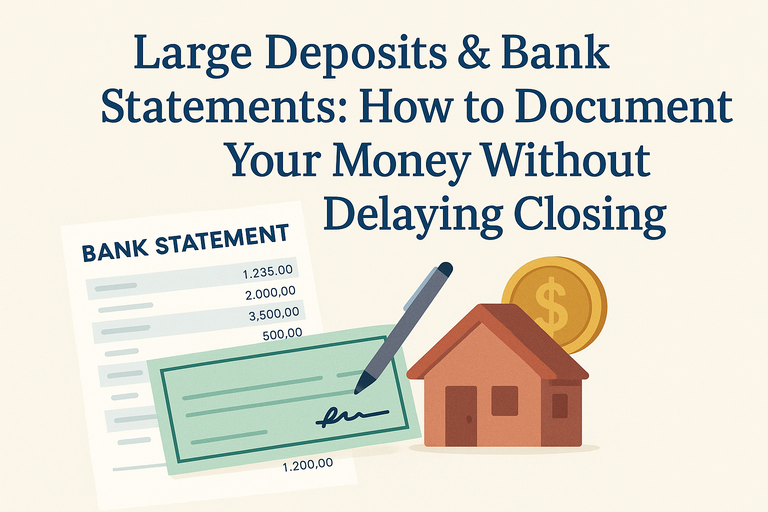
Large deposits are one of the most common reasons a Miami mortgage file gets stuck in underwriting. Not because the money is “bad,” but because lenders must prove it’s sourced, seasoned, and acceptable under anti–money laundering rules and loan guidelines.
If you want a smooth closing, treat every big deposit like it’s guilty until proven innocent.
What counts as a “large deposit”?
There’s no single magic number across all lenders. In practice, it’s any deposit that’s unusual for your normal banking pattern and big enough to matter for qualifying assets or cash-to-close.
Underwriting flags deposits because they need to confirm:
- it’s your money (or an acceptable gift)
- it’s not borrowed (undisclosed debt)
- it’s not from an unacceptable source (cash, unverified business, etc.)
The fastest way to avoid the problem: don’t create it
Before you apply—or at least before underwriting—avoid:
- cash deposits
- money moved through multiple accounts
- “temporary” transfers from friends
- deposits that appear right before closing with no paper trail
If you’re self-employed or using alternative docs, this gets even more sensitive.
How to document large deposits (the exact playbook)
1) Identify the source category
Underwriting wants a clean explanation tied to documents. Most deposits fall into one of these:
A) Payroll / regular income
- Provide paystubs or payroll statement matching the deposit.
B) Sale of an asset (car, stocks, crypto, etc.)
- Provide bill of sale + proof of ownership + proof of proceeds.
- If it’s securities, provide brokerage statements showing the sale and transfer.
C) Business revenue
- Provide business bank statements + invoices/contracts.
- Be ready to show it’s not a loan.
D) Gift funds
Gifts must be documented properly (gift letter + donor ability + transfer trail).
E) Transfer between your own accounts
- Provide statements for both accounts showing the withdrawal and deposit.
- Keep dates and amounts aligned.
2) Build a “three-part” proof set (this wins approvals)
For almost any large deposit, aim to provide:
- Evidence of origin (where it came from)
- Evidence of transfer (wire/ACH/check image/receipt)
- Evidence of arrival (bank statement showing it credited)
If you can’t produce all three, underwriting will either condition you repeatedly or exclude the funds from usable assets.
3) Write a clean, boring letter of explanation (LOE)
Underwriters love boring. Your LOE should be short and match the documents:
- Date of deposit
- Amount
- Source
- Why it exists
- Cross-reference to the documents you attached
Example (style, not a template to copy blindly):
“On Aug 12, 2025, $18,500 was deposited into my checking account from the sale of my vehicle. Attached: bill of sale, buyer’s payment confirmation, and bank statement showing deposit.”
No storytelling. No emotions. Just traceability.
The deposits that cause the most pain (don’t do these)
Cash deposits
Cash is hard to source. Many lenders will not accept it for qualifying funds, even if you swear it’s legit.
“Friend wired me money temporarily”
That looks like a loan. It can trigger questions about undisclosed debt, which is the fastest route to delays.
Crypto proceeds with no trail
Crypto is documentable, but only if you can show:
- ownership
- sale on an exchange
- transfer to your bank
If it’s wallet-to-wallet then cash deposit—good luck.
Large deposits right before closing
Even clean deposits can delay you if they show up late. Underwriting moves slower than your timeline.
Bank statement loans: extra strict about consistency
If you’re using a bank statement program, inconsistent deposits and unexplained spikes can change your qualifying income or trigger deeper review.
If that’s your path, keep this internal page as the natural interlink:
- https://mymiamimortgagebroker.com/bank-statement-loans-miami/
The “do this and you won’t suffer” checklist
- Avoid cash deposits during the mortgage process
- Don’t move money through extra accounts “for convenience”
- Keep receipts for any sale, bonus, or transfer
- Provide the 3-part proof set (origin → transfer → arrival)
- Disclose deposits early, not when you get caught
- If money is a gift, document it correctly from day one
Bottom line
Large deposits don’t kill loans. Undocumented large deposits do. The goal is simple: make your money trail so clear that underwriting has nothing to argue with.