Skip to content

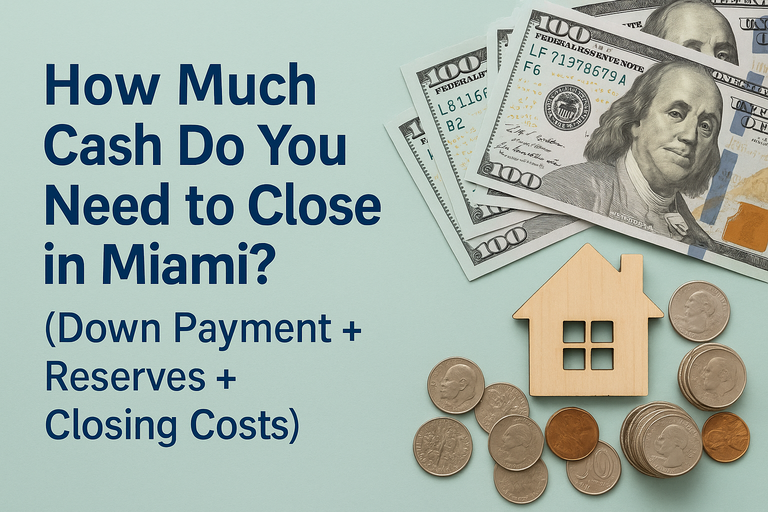
Most Miami buyers underestimate cash-to-close because they fixate on the down payment and forget the rest: closing costs, escrows, and sometimes reserves. Then they’re shocked a week before closing.
Here’s how to estimate it properly—without wishful thinking.
The 3 buckets of money you need
1) Down payment (varies by loan type)
Typical ranges you’ll see:
- Conventional: often 3%–5% down for qualified primary-residence buyers; higher for second homes/investment.
- FHA: typically 3.5% down if you qualify.
- VA: can be 0% down for eligible veterans (but not “zero money needed”).
- Jumbo: commonly 10%–20%+ down depending on profile and property.
- Investor (DSCR / non-QM): often 20%–30% down in practice.
Down payment is the headline number—but it’s rarely the biggest surprise.
2) Closing costs (the fees you can’t avoid)
In Miami/Florida, closing costs commonly include:
- lender fees (origination/underwriting)
- appraisal, credit, flood cert (small but real)
- title search + title insurance + settlement fees
- recording fees, doc stamps (where applicable), county costs
- prepaid interest (from closing date to month-end)
Typical range: A lot of buyers land somewhere around 2%–5% of the purchase price in total closing costs, but it can swing based on loan type, points/credits, and title/insurance specifics.
If you want the clearest internal explainer on the title side, link this in your cluster:
3) Prepaids + escrows (the Miami budget killer)
Even if your “closing costs” look reasonable, escrows can inflate cash-to-close because lenders often collect:
- a few months of property taxes
- a few months of homeowners insurance
- sometimes flood insurance (zone-dependent)
- plus your first year insurance premium (depending on timing/provider)
Miami-specific reality: insurance can be large, and some carriers require big upfront payments. So you might have the down payment saved and still be short at the table.
What are “reserves,” and do you need them?
Reserves are funds you must have left over after closing (not spent on cash-to-close). They’re measured in “months of housing payment” (PITI + HOA).
Not every loan requires reserves, but they’re common in:
- jumbo loans
- investment property loans
- higher-DTI or riskier scenarios
- some condo situations
- non-QM programs
Rule of thumb: if you’re buying in Miami with a condo HOA and a larger loan, assume reserves might show up even if you didn’t plan for them.
Miami example: $600,000 purchase (primary residence)
Let’s use realistic structure, not fantasy.
Scenario A: Conventional with 5% down
- Purchase price: $600,000
- Down payment (5%): $30,000
Now add:
- Closing costs (estimate 3%): $18,000
- Prepaids/escrows (example range): $6,000–$12,000 (insurance + taxes + timing dependent)
Estimated cash to close:
$30,000 + $18,000 + ($6,000–$12,000) = $54,000–$60,000
Then reserves (if required): could be 2–6 months of full housing payment depending on profile and program.
Scenario B: FHA with 3.5% down
- Down payment (3.5%): $21,000
- Closing costs (often similar range, depends on credits/fees): $15,000–$20,000
- Prepaids/escrows: $6,000–$12,000
Estimated cash to close: $42,000–$53,000 (very rough but directionally real)
Scenario C: VA with 0% down
- Down payment: $0
- Closing costs + prepaids/escrows still exist
Estimated cash to close: often still $15,000–$30,000+ depending on insurance/escrows, concessions, and fees.
“Zero down” is not “zero cash.” Don’t lie to yourself.
How to reduce cash-to-close (without sabotaging the loan)
- Negotiate seller concessions (especially if the home sat on market)
- Use lender credits instead of paying points (trade-off: higher rate)
- Choose closing date strategically (prepaid interest changes)
- Shop insurance early (binders and upfront premiums affect required funds)
- Don’t drain reserves—underwriting may require leftover liquidity
If you want an internal interlink for negotiating smarter with lenders, use:
Bottom line
In Miami, you need cash for down payment + closing costs + prepaids/escrows, and sometimes post-close reserves. The mistake is budgeting only for the down payment.