In Miami-Dade, your flood zone isn’t trivia—it can change your monthly payment, your cash-to-close, and sometimes your ability to close on time. Lenders don’t “prefer” flood insurance. In many cases, they’re legally required to make sure it’s in place before funding.
Here’s how FEMA maps drive the outcome and what you should do before you get blindsided.
What FEMA flood maps are (and why lenders use them)
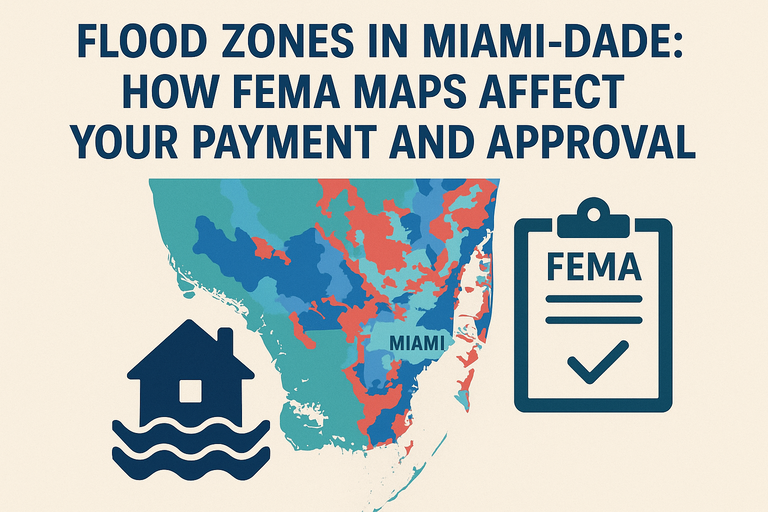
FEMA’s Flood Insurance Rate Maps (FIRMs) identify flood risk zones and Special Flood Hazard Areas (SFHAs). FEMA notes flood maps are the official source used for flood risk and are used by lenders to determine insurance requirements.
You can pull the official map products through FEMA’s Map Service Center.
Miami-Dade also publishes local guidance and points to FEMA’s map tools (including preliminary maps).
The zones that matter most for mortgages (Miami-Dade quick guide)
High-risk zones (SFHA): A / AE / AH / AO / V / VE
If the structure securing the loan is in an SFHA, flood insurance is typically mandatory for federally related mortgages when NFIP insurance is available.
- AE / A: high flood risk; AE usually includes Base Flood Elevations (BFEs) shown on the map.
- VE / V: coastal high hazard areas (wave action).
Lower-risk zones: X (shaded or unshaded)
Zone X is generally considered lower flood risk than SFHA zones, and flood insurance is usually not mandatory—though it can still be smart depending on property-specific risk.
How the flood zone affects your monthly payment
Flood insurance can add a meaningful monthly cost because it’s often escrowed into your mortgage payment (like homeowners insurance and taxes). That impacts:
- DTI (debt-to-income): higher insurance can push you over program limits.
- Cash-to-close: some policies require significant upfront premium to bind.
- Payment shock: quotes can change once elevation certificates or building details are reviewed.
If you already understand how insurance can make approvals harder in Miami, this ties directly into your existing piece:
How FEMA maps affect approval (the underwriting chain reaction)
1) Lender flood determination happens early
The lender orders a flood determination using FEMA mapping. If it comes back SFHA, underwriting will condition the file for a flood policy and proof of coverage before closing.
2) “Any portion of a building” can trigger the requirement
Regulator guidance clarifies that if any portion of a building is in an SFHA (and insurance is available), the mandatory purchase requirement applies. (Federal Reserve)
3) Private flood insurance can be acceptable—but must meet requirements
Some loans can satisfy the requirement with private flood insurance, but it still must meet coverage and lender/regulatory standards. (eCFR)
The common Miami-Dade closing delays (and how to avoid them)
Delay #1: Waiting until the last week to shop flood insurance
Don’t. Start quoting as soon as you’re under contract, especially in coastal/low-lying areas.
Delay #2: Confusion about condo coverage
If you’re buying a condo, there may be a master policy (association) and an individual policy (unit). Lenders will still require the correct documentation showing adequate coverage and listing the lender properly.
Delay #3: Map disputes too late (LOMA/LOMR)
Sometimes a property is mapped into an SFHA but may qualify for a map amendment (e.g., LOMA). That process can take time. If you think the map is wrong, address it early—not after underwriting conditions are issued.
Miami-Dade explicitly directs property owners to confirm zones and use FEMA map resources. (Miami-Dade County)
Practical checklist: what to do before your offer (or right after acceptance)
- ✅ Look up the address on FEMA’s Map Service Center / flood tools
- ✅ Assume SFHA = flood insurance required for most federally related mortgages
- ✅ Get flood quotes early and send the binder to your lender
- ✅ If condo: request master policy info immediately
- ✅ Build the flood premium into your budget and DTI from day one
For the lender-side questions that prevent last-minute surprises, interlink:
Bottom line
In Miami-Dade, FEMA flood zones can change your payment enough to affect approval, and SFHA status can create a hard underwriting requirement for flood coverage. Treat flood insurance like a core part of affordability—not an afterthought—and you’ll close faster. (FEMA)