Skip to content

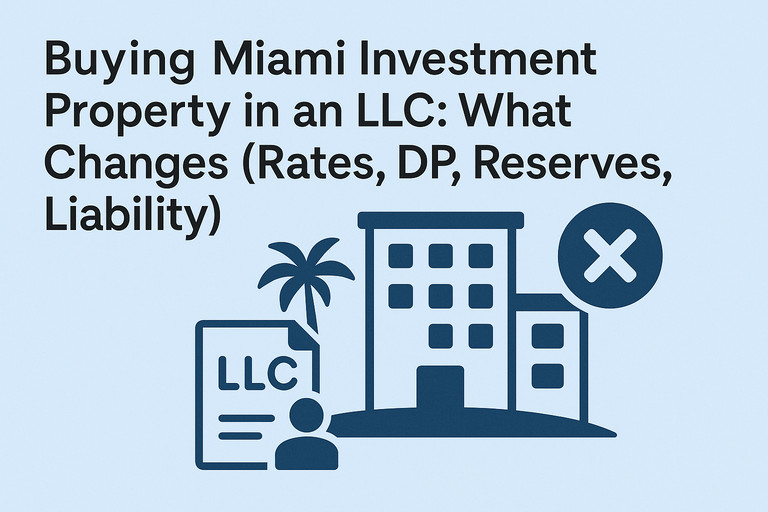
Buying an investment property in Miami through an LLC can be smart—but most investors do it for the wrong reasons and then get shocked by the financing terms. The lender doesn’t care about your “asset protection story.” They care about risk, recourse, and exit liquidity. An LLC increases perceived risk, so underwriting usually tightens.
Here’s what changes in the real world: rates, down payment, reserves, documentation, and liability.
1) Financing options: conventional vs DSCR vs portfolio (LLC usually pushes you here)
Conventional (Fannie/Freddie)
Standard conventional investment mortgages are generally consumer loans to individuals, not LLCs. If you want LLC title, you’re usually looking at:
- DSCR loans
- portfolio investor loans
- commercial-style financing
DSCR / Portfolio (most common for LLC-held Miami rentals)
These programs often allow LLC vesting, but usually require:
- personal guarantee (recourse) from the owners
- stronger reserves
- more down payment
Post that fits this cluster:
2) Rates: usually higher (and sometimes materially)
LLC/investor loans are priced for:
- non-owner occupancy risk
- rental income variability
- reduced consumer protections
- added complexity and servicing risk
Translation: expect rates to be higher than owner-occupied conventional, and often higher than a personally-held investment conventional option (when that option exists and fits).
Also, points/prepay penalties are more common on LLC-friendly investor products. Don’t pretend you’ll “refi soon” unless you’ve run the numbers.
3) Down payment: typically larger
Miami investment LLC purchases frequently land in these practical ranges:
- 20%–25%+ down for many DSCR/portfolio programs
- 25%–30%+ down for higher-risk property types (condos, short-term rentals, unique properties)
The real driver is LTV + risk layering:
- condo + HOA + special assessments = higher down or tighter terms
- short-term rental underwriting = higher down or more reserves
- weak DSCR = higher down or smaller loan
4) Reserves: lenders expect you to have real liquidity
LLC deals almost always come with reserve requirements (months of PITIA). In Miami, add HOA dues to that “A.”
Reserves get higher when:
- it’s a condo
- the loan amount is large (jumbo-ish)
- the borrower has multiple financed properties
- the DSCR is tight
If you try to empty accounts to close, underwriting can stop you.
5) Documentation: expect more, not less
Even on DSCR loans, LLC vesting usually means more documentation than buying personally.
Common requirements:
- LLC Articles of Organization / Operating Agreement
- EIN letter
- Certificate of Good Standing (sometimes)
- LLC resolution to borrow / sign
- Identification for all members/managers
- Proof of ownership percentages
And yes—most lenders still underwrite you, even if they claim they don’t:
- credit report on guarantors
- background on real estate owned (REO schedule)
- sometimes experience / liquidity review
6) Liability: the part investors misunderstand (brutal truth)
What an LLC can help with
An LLC can help isolate property-level liability (tenant injury claims, contract disputes) if:
- you maintain corporate formalities
- you don’t commingle funds
- you have proper insurance
- you don’t personally create liability through actions/contracts
What an LLC does NOT magically solve
- Your lender will often require a personal guarantee, which means you’re still on the hook for the debt.
- LLC protection doesn’t replace adequate insurance.
- If you mix personal and LLC finances, you weaken the shield.
Bottom line: LLCs are mainly about liability compartmentalization, not “escaping responsibility.” Financing will still tie back to you.
7) Miami-specific landmines for LLC investors
- Condos + HOA restrictions: rental caps, minimum lease terms, approval processes
- Special assessments: can hit cash flow and DSCR hard
- Insurance volatility: higher premiums increase PITIA and crush DSCR
- Flood zones: required flood insurance adds cost and underwriting friction
- Short-term rental rules: city + HOA compliance can decide whether income is even usable
If you want an read post that pairs well here:
The decision framework (use this, not vibes)
Buying in an LLC makes sense when:
- you’re building a portfolio and want property-level separation
- you have enough reserves to handle stricter underwriting
- you understand you’ll likely sign a personal guarantee anyway
- you’re holding long enough that slightly higher rate doesn’t kill returns
Buying personally is often smarter when:
- you qualify for better pricing personally
- you want maximum flexibility to refinance/sell
- the property is “borderline” on DSCR and you need the best terms
Bottom line
Buying a Miami investment property in an LLC usually means higher rate, higher down payment, higher reserve requirements, and more paperwork. Liability protection can be real—but only if you run it professionally and don’t expect the LLC to eliminate personal responsibility for the loan.