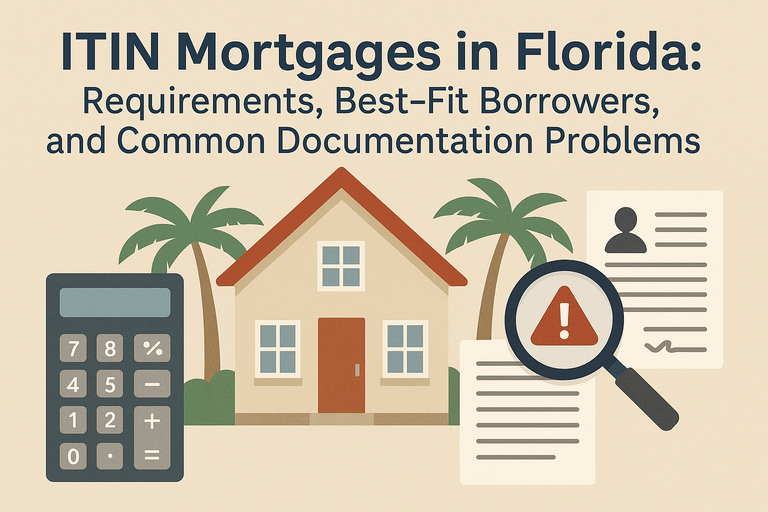
If you’re shopping for a mortgage in Florida with an ITIN instead of a Social Security Number, you are not playing in the standard Fannie/Freddie/FHA sandbox. You’re in Non-QM / specialty lending, where the rules are lender-made, pricing is higher, and documentation mistakes kill deals fast.
Here’s what actually works—and where ITIN borrowers blow themselves up.
1. What an ITIN Mortgage Really Is (and Isn’t)
An ITIN mortgage is a non-traditional loan for borrowers who file U.S. taxes using an Individual Taxpayer Identification Number (ITIN) instead of an SSN. These are typically portfolio / Non-QM loans, not government or agency loans.
Key reality checks:
- Fannie/Freddie/FHA/VA = generally off the table without an SSN and eligible status. Lenders offering ITIN loans do so under their own Non-QM programs.
- Higher risk = higher rate + bigger down payment + more reserves.
If you’re expecting “ITIN with FHA pricing,” you’re delusional. Lenders are taking more risk; they price it accordingly.
2. Best-Fit Borrowers for ITIN Mortgages
ITIN mortgage products are usually built for borrowers who:
- Live and work in the U.S., but don’t have an SSN
- File tax returns with an ITIN and can document income (W-2 style, 1099, or self-employed)
- Have established credit alternatives (U.S. or foreign) even if they lack a traditional FICO
- Have real skin in the game (often 15–25%+ down, lender-dependent)
If you’re self-employed, ITIN often overlaps with bank statement / alternative doc underwriting, which you already have content for:
3. Core Requirements (Across Most ITIN Lenders)
Each lender writes its own rules, but patterns are obvious:
A. Identification & Legal Presence
- Valid ITIN
- Acceptable photo ID (passport; sometimes foreign government ID; sometimes U.S. driver’s license or state ID if available)
- Evidence of current U.S. address and often residency history
If you can’t document where you live and who you are in a way that holds up, no serious lender will touch the file.
B. Income Documentation
Depends on how you earn:
- W-2/Payroll ITIN borrowers
- Recent pay stubs (typically 30 days)
- 1–2 years of tax returns (with ITIN)
- Employer verification
- Self-Employed / 1099 ITIN borrowers
- 1–2 years personal and/or business tax returns or
- Bank statements (12–24 months) if using an alt-doc / bank-statement Non-QM structure
- Business registration docs if applicable
If your tax returns show almost no income because everything is written off, don’t act surprised when you can’t qualify conventionally.
C. Credit & Payment History
- Some ITIN lenders will use alternative credit (rent history, utilities, etc.) if no FICO.
- Others want foreign credit reports plus U.S. trade lines.
- You’ll usually need a clean recent history of rent or housing payments.
No, “I always pay in cash and nothing is documented” is not an advantage. It’s a liability.
D. Down Payment & Reserves
- Expect 15–25%+ down depending on property type, occupancy, and risk.
- Expect reserves (months of full payment left over after closing).
This is not the space for “3% down and I’m broke after closing.”
4. The Most Common ITIN Documentation Problems (and How to Avoid Them)
Problem 1: Inconsistent Identity Across Documents
Name variations, mismatched addresses, or different birthdates across:
- passport
- tax returns
- bank statements
- employment docs
Fix:
- Standardize your name/spelling.
- Make sure your tax returns, bank accounts, and ID all match.
- Be ready with a clean letter of explanation if there’s a legitimate variation (maiden name, transliteration, etc.).
Problem 2: Sloppy Tax Return History
ITIN borrowers often:
- file late
- file incomplete returns
- or show tiny income due to aggressive write-offs.
Then they wonder why they can’t qualify on income.
Fix:
- File complete, consistent tax returns before you apply.
- If you’re going to use bank-statement style underwriting instead, structure your finances intentionally 12–24 months ahead.
Problem 3: Cash-Only Habits
Large cash deposits, undocumented business cash, and no traceable rent or bill payments make underwriters nervous.
Fix:
- Start paying rent via traceable methods (check, transfer, Zelle) and keep records.
- Avoid unexplained cash deposits during the mortgage process.
- Document the source of any large deposit (sale of asset, business income, etc.).
You’ve already got a strong related post companion for this:
Problem 4: Title / Ownership Expectations
Some ITIN borrowers assume:
- they can “hide” behind an LLC with no personal responsibility
- or mix multiple family members on title/loan casually
In reality, most Non-QM/ITIN lenders will demand personal guarantees from real decision makers and will look closely at the ownership structure.
Fix:
- Decide who will be on the loan and who will be on title up front.
- Don’t overcomplicate the ownership structure unless you actually need it.
5. Who Should Not Use an ITIN Mortgage
Harsh but true—you probably shouldn’t force ITIN financing if:
- You’re right on the edge of legal/immigration issues and can’t safely provide documentation.
- You have almost no verifiable income or ability to show bank activity.
- You’re expecting “low down, lowest rate, minimal paperwork.” That’s not this world.
Your move is either:
- get your documentation life together first, or
- accept that renting is safer until your file is real and defensible.
Bottom Line
ITIN mortgages in Florida are built for serious, documented borrowers who happen not to have an SSN—but can prove identity, income, and stability. They’re Non-QM products: higher rate, higher down payment, more reserves, less tolerance for messy paperwork.