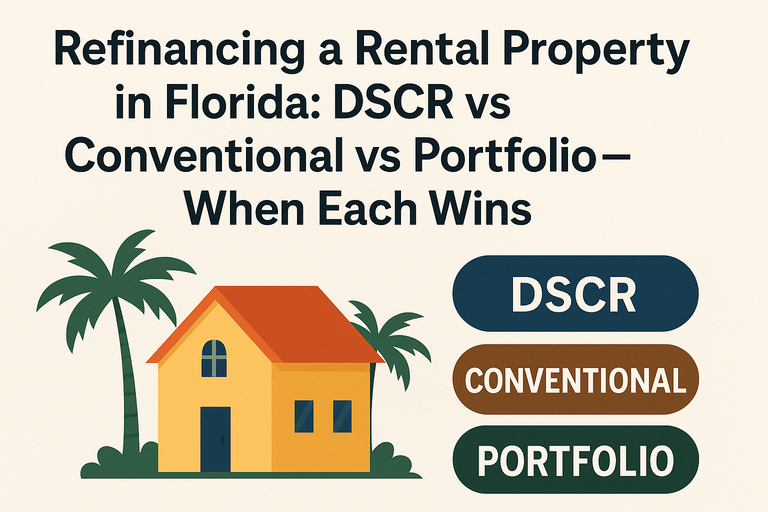
Refinancing a Florida rental isn’t about finding “the lowest rate.” It’s about choosing the loan type that fits your income documentation, property cash flow, and exit plan. The wrong choice wastes months, triggers underwriting chaos, or boxes you into bad terms.
Here’s how DSCR, conventional, and portfolio refis compare—and when each one is the smart move.
The 3 refinance paths (what they really are)
1) DSCR refinance (property-based)
DSCR (Debt Service Coverage Ratio) loans underwrite the deal mostly on whether the property income covers the housing payment. Your personal income matters far less than in conventional.
Best fit: investors who want speed and flexibility, especially self-employed borrowers or people who don’t want tax-return underwriting.
Post reference if you want to read:
2) Conventional refinance (borrower-based)
Conventional (Fannie/Freddie) refis focus heavily on your personal income, DTI, and documentation. They can be excellent when your financials are clean and your portfolio isn’t too complex.
Best fit: W-2 borrowers (or clean-documentation self-employed) who want strong long-term pricing and standard terms.
3) Portfolio refinance (lender-specific rules)
Portfolio means the lender keeps the loan and can bend guidelines more than conventional. Portfolio can look like DSCR, but it’s broader: banks/credit unions or specialty lenders with their own “common-sense” rules.
Best fit: properties or borrowers that don’t fit cleanly into DSCR or conventional (unique condos, mixed use, complex income, or “edge-case” deals).
When DSCR wins (and why)
Choose DSCR when these are true:
You don’t want personal income scrutiny
If your tax returns show big write-offs, inconsistent income, or you’re scaling a portfolio fast, conventional underwriting becomes a headache.
The property cash flow is strong enough
DSCR lives and dies on rent vs payment. If rent supports the debt service, DSCR can be the cleanest refinance tool.
You’re optimizing for speed and scalability
DSCR is often the “repeatable” solution for investors doing multiple acquisitions/refis.
DSCR loses when: the property’s income doesn’t support the payment (especially with high insurance/HOA) or the rent is hard to document (STR complexity, HOA rules).
Helpful Post for income documentation issues:
When Conventional wins (and why)
Conventional is usually the best choice when:
You have strong documented income and manageable DTI
If you’re W-2, or your self-employed income is clean and consistent, conventional can reward you.
You plan to hold long-term and care about “clean” terms
Conventional is typically the most standardized and predictable: fewer weird prepay penalties and fewer “gotchas” (depends on lender and product, but generally more consumer-friendly).
The property is “boring” (in a good way)
Standard single-family rentals or warrantable condos are the easiest fit.
Conventional loses when: your tax returns don’t support your real cash flow, you have too many financed properties, or the property is non-standard (certain condos, unique properties, heavy HOA issues).
When Portfolio wins (and why)
Portfolio is your “problem-solver” option. Pick portfolio when:
The property is hard to underwrite conventionally
Examples: non-warrantable condos, unique properties, mixed-use, higher-risk condo projects, or buildings with HOA complexities.
You need flexibility on assets or documentation
Portfolio lenders may accept alternative documentation, larger reserves, or asset-based strength.
You want relationship banking
Some portfolio lenders care more about your full relationship (assets, deposits, other business) than a rigid automated approval.
Portfolio loses when: the lender’s terms are punitive (rate, fees, prepay penalty) or their underwriting drags because it’s manual and conservative.
Decision rules (use these instead of guessing)
Pick DSCR if:
- Your personal income docs are messy or you’re self-employed with heavy write-offs
- The property cash flow supports the payment cleanly
- You want repeatable financing for a growing portfolio
Pick Conventional if:
- You can document strong income and DTI works
- You want the most standardized long-term structure
- The property type fits agency guidelines
Pick Portfolio if:
- The property is “weird” (condo project issues, mixed-use, unique collateral)
- You need lender flexibility and can trade cost for approval
- You’re solving a specific constraint DSCR/conventional can’t handle
The underwriting “gotchas” that decide your outcome
No matter which you choose, these are the issues that wreck refis in Florida:
- Insurance costs raising your payment and killing qualification/DSCR
- HOA dues and special assessments (condos are brutal here)
- Large deposits / messy bank statements that trigger sourcing conditions
- Appraisal gaps (especially if you’re counting on a high value for cash-out)
- Prepayment penalties on investor-focused products (don’t pretend they don’t matter)
If you want a clean internal piece to support “document your money correctly”:
Bottom line
- DSCR wins when the property is strong and you want speed + scalability.
- Conventional wins when you are strong on paper and you want clean, standardized terms.
- Portfolio wins when the deal is non-standard and flexibility is the price of approval.