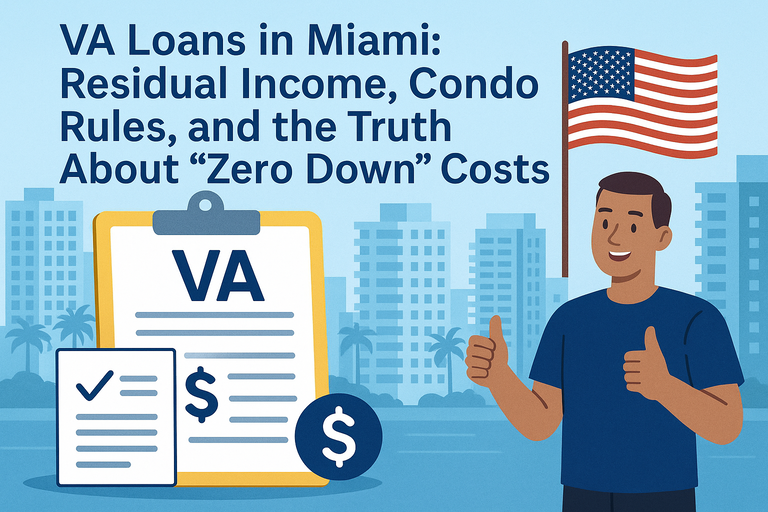
VA loans are one of the best benefits in housing—but Miami is where sloppy assumptions get expensive. The three places buyers get blindsided are residual income, condo approval, and thinking “zero down” means “no money needed.”
1) Residual income: VA’s real affordability test
Most loan programs obsess over DTI. VA cares about how many dollars you have left each month after bills—that’s residual income. VA defines it as net income remaining after deducting debts/obligations and monthly shelter expenses to cover family living expenses.
Miami angle: high insurance + HOA dues hit residual hard
In Miami, your “shelter expense” often includes:
- higher homeowners insurance (and sometimes flood)
- HOA/condo dues
- property taxes/escrows that can be chunky
So two buyers with the same income can have totally different outcomes based on HOA + insurance alone.
Residual income minimums (Miami = “South” region)
VA uses tables by region + family size. For loan amounts $80,000 and above, the South residual income guidelines are:
- Family size 1: $441/mo
- 2: $738/mo
- 3: $889/mo
- 4: $1,003/mo
- 5: $1,039/mo
Important nuance: residual income is a guide, not an auto-approval. But inadequate residual income alone can still be a basis to disapprove.
The 41% DTI “myth” (it matters, but not how people think)
VA says DTI is also a guide and secondary to residual income.
If DTI is over 41%, the file gets close scrutiny unless residual income exceeds the guideline by 20%+ (or other specific circumstances).
Translation: if you’re stretching DTI in Miami, you’d better be strong on residual.
2) VA condo rules: not every Miami condo is eligible
Here’s the blunt rule: condominiums must be approved by VA before units in the project are eligible for VA loan guaranty.
VA also maintains a condo/PUD/builder list accessible through its system (not your agent’s MLS notes).
Common Miami condo deal-killers (VA-specific reality)
- Building not VA-approved (most common)
- HOA/management won’t provide documents fast enough (your rate lock and closing date don’t care)
- High HOA dues + insurance crush residual income even if the condo is technically eligible
If you’re shopping condos, you should treat “VA-eligible building?” like a non-negotiable filter, not a “we’ll see later” detail.
3) The truth about “zero down”: you can still need real cash
VA often allows 0% down, but it does not mean $0 to close.
Costs buyers still face
- VA funding fee (many borrowers pay it; some are exempt). VA explains how the funding fee works and provides the funding fee rate charts.
- Closing costs (title, lender fees, recording, prepaid escrows, etc.). VA outlines what closing costs are and that they vary.
- Prepaids/escrows (insurance + taxes), which can be big in Miami
How “zero down” actually becomes “low cash”
- Seller concessions (when negotiated correctly)
- Lender credits (usually via rate pricing)
- Funding fee financed into the loan (common, if eligible)
If you don’t plan this before you offer, you’ll either (1) scramble for cash, or (2) start renegotiating mid-transaction and look weak.
Miami buyer move: do this before you go under contract
- Run a residual-income-first pre-approval (don’t just chase a max loan amount).
- Verify condo VA approval early (don’t rely on “should be fine”).
- Get a real cash-to-close estimate even at 0% down (funding fee + escrows + fees). (Veterans Affairs)