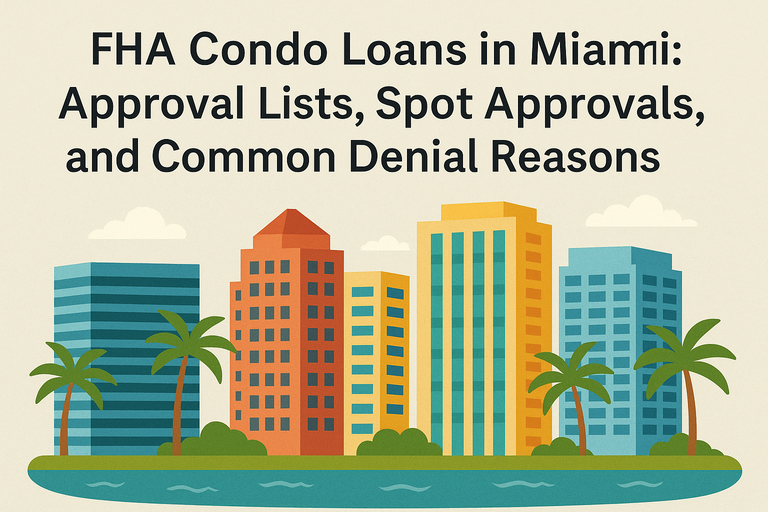
FHA can be a great path for Miami condo buyers—but only if the condo project (or your single unit) meets FHA rules. The #1 mistake is going under contract first and “hoping it’s FHA-approved.” That’s how timelines blow up.
1) How to check if a Miami condo is FHA-approved (the official list)
HUD maintains the official database of FHA-approved condominium projects. You can search by condo name, city, ZIP, and approval status.
Reality check: A building being “financeable” for conventional buyers does not automatically mean it’s FHA-approved. FHA has its own approval system.
2) If it’s not on the list: FHA “Spot Approval” (Single-Unit Approval / SUA)
If the condo project isn’t FHA-approved, FHA may still allow financing via Single-Unit Approval (often called “spot approval”). HUD publishes a required documentation list for SUA and ties it back to Handbook 4000.1.
In plain English: your lender must document the condo’s eligibility at the project level even though the project isn’t fully FHA-approved.
The core “spot approval” thresholds buyers should know
Industry summaries (aligned with FHA’s 2019 condo rule changes) commonly reference these baseline thresholds:
- project has at least 5 units
- owner-occupancy around 50%+
- commercial space capped (commonly 35% max)
- limits on FHA-insured concentration
Miami warning: Condos with heavy investor ownership, large commercial components, or ongoing disputes are where spot approvals die.
3) Full project approval: HRAP vs DELRAP (who approves the building)
If a condo association wants to open the door to more FHA buyers, the project can pursue approval through:
- HRAP (HUD Review and Approval Process), or
- DELRAP (Direct Endorsement Lender Review and Approval Process—approved lenders can review/submit).
Buyers usually don’t control this, but it explains why some buildings become “FHA friendly” over time and others never do.
Common denial reasons (and what to do about them)
1) The condo association can’t/won’t produce documents
Spot approvals live or die on paperwork. If the HOA/management company is slow or refuses to cooperate, your lender can’t clear conditions.
Fix: ask for HOA docs before you go under contract if FHA matters to you.
2) Owner-occupancy is too low
FHA is trying to avoid investor-dominated projects. Low owner-occupancy is a classic denial trigger (especially in Miami).
Fix: none as a buyer. You pick a different building or different loan type.
3) Too much commercial / non-residential space
Mixed-use buildings can fail FHA thresholds when commercial space is too high.
Fix: verify early—don’t assume a “nice lobby retail” won’t matter.
4) Litigation
Active litigation can make projects ineligible depending on type/severity, and it often scares lenders even when technically allowable.
Fix: ask directly and review meeting minutes; if there’s active litigation, expect delays or denial.
5) Financial instability: reserves, delinquencies, assessments
Thin reserves, too many owners behind on dues, or special assessments can trigger deeper review and denials.
6) Insurance problems (coverage gaps, deductibles, master policy issues)
FHA condo approvals are sensitive to proper hazard/flood coverage and master policy structure. When insurance docs don’t match requirements, underwriting stalls.
Fix: request master policy declarations early; don’t wait for “clear to close.”
7) Project is too small / too new / doesn’t meet occupancy/CO rules
Some projects won’t qualify for SUA if they’re too small or not sufficiently complete/occupied; FHA policy is detailed in Handbook 4000.1 and supporting guidance.
What Miami buyers should do before going under contract (fast checklist)
- Search the building in HUD’s FHA condo database
- If not approved: ask your lender in writing if they will attempt Single-Unit Approval and what they need
- Get HOA budget, reserves, insurance, and minutes immediately
- Build time into the contract—condo docs are a common delay source
- Pressure-test your lender with the right questions:
https://mymiamimortgagebroker.com/questions-to-ask-a-mortgage-lender-before-applying/
Bottom line
In Miami, FHA condo financing is less about you and more about whether the building can pass FHA’s project/single-unit filters. Check the HUD approval list first, and if you need spot approval, treat HOA documents like mission-critical underwriting—because they are. (entp.hud.gov)