In Miami, “I’m pre-qualified” is often treated like “I clicked a button online.” Sellers don’t care about your optimism. They care about certainty, speed, and low fall-through risk—especially when multiple offers hit the table.
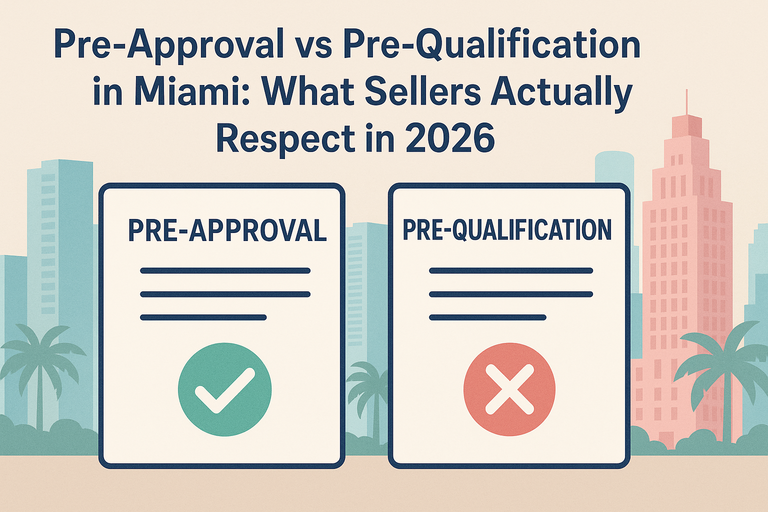
Here’s the real difference between pre-qualification and pre-approval, and what makes a seller take your offer seriously in 2026.
Pre-Qualification: a quick estimate (low credibility)
A pre-qualification is usually a lender’s informal estimate based on what you say about income, debts, and assets. Sometimes it includes a soft credit pull; sometimes none.
Why sellers don’t respect it
Because it often means:
- income wasn’t verified
- assets weren’t verified
- debts weren’t fully reviewed
- the number can change dramatically once underwriting sees the real file
In a competitive Miami deal, a pre-qual letter signals higher risk of denial or delay.
Pre-Approval: a documented loan decision (high credibility)
A true pre-approval means the lender has reviewed real documentation:
- income docs (W-2s/paystubs or self-employed docs)
- assets (bank statements)
- credit report
- basic underwriting inputs for the loan program
It’s still not a final commitment (the property must qualify too), but it’s much closer to “this borrower can close.”
What sellers actually hear when they see a strong pre-approval
- “This buyer won’t implode during underwriting.”
- “This buyer can close on time.”
- “This buyer won’t come back begging for extensions.”
The Miami twist: “pre-approval” letters are often fake
Brutally honest: plenty of “pre-approval” letters are glorified pre-quals with a nicer font.
A seller (and listing agent) in 2026 is looking for signals like:
- a specific loan amount (not “up to $2M” with no basis)
- a short closing timeline that matches reality
- confidence that the buyer’s cash-to-close is legit
- lender responsiveness (local reputation matters)
If your lender can’t answer quickly when the listing agent calls, your offer weakens—even if your price is strong.
What sellers respect most (ranked)
1) Underwritten pre-approval (gold standard)
This is when your file is reviewed by an underwriter before you go under contract. Not every lender offers it, but when they do, it’s a serious advantage.
2) Fully documented pre-approval with verified assets
If you’ve already provided full bank statements, income docs, and had credit pulled, you’re ahead of most buyers.
3) Pre-qualification (only helpful if the market is slow)
In a fast-moving Miami market, pre-qual is a weak signal.
What makes a pre-approval “strong” in Miami (and wins offers)
A) You can explain your cash-to-close cleanly
Sellers don’t want “my cousin is wiring me money later.” They want certainty.
If gifts are involved, make sure the money trail is clean—this is a common underwriting delay:
- https://mymiamimortgagebroker.com/how-to-save-for-a-house-your-2025-guide-to-homeownership/ (good budgeting context)
- https://mymiamimortgagebroker.com/questions-to-ask-a-mortgage-lender-before-applying/ (use this to pressure-test your lender)
B) You avoid the “suspense item” traps before you shop
Pre-approval gets weaker if underwriting finds:
- unexplained large deposits
- new debt
- job changes
- missing pages in bank statements
A smart buyer behaves like underwriting is watching—because it is.
C) Your letter matches the offer strategy
A credible letter should align with:
- purchase price
- down payment type
- loan program (conventional/FHA/VA/jumbo/non-QM)
- closing timeline
A generic letter that doesn’t match the offer looks sloppy and invites doubt.
“But I already have a pre-approval—why did my offer still lose?”
Because Miami sellers are not only comparing price. They’re comparing risk.
You can lose even with a higher offer if:
- the lender seems slow or unknown
- your financing looks shaky (thin down payment, borderline DTI, messy assets)
- your timeline doesn’t feel believable
- your offer has too many “ifs” (inspection + appraisal + financing with no strength indicators)
The 2026 playbook: what you should do before making offers
- Get a fully documented pre-approval (not a pre-qual)
- Ask if the lender offers underwritten pre-approval
- Keep assets stable (no weird transfers, no cash deposits)
- Don’t open new credit while shopping
- Have your lender ready to call the listing agent same day
Bottom line
In Miami in 2026, sellers respect proof, not promises. Pre-qualification is a rough guess. Pre-approval is a verified file. And an underwritten pre-approval is the closest thing to a competitive weapon you can bring—without raising your price.