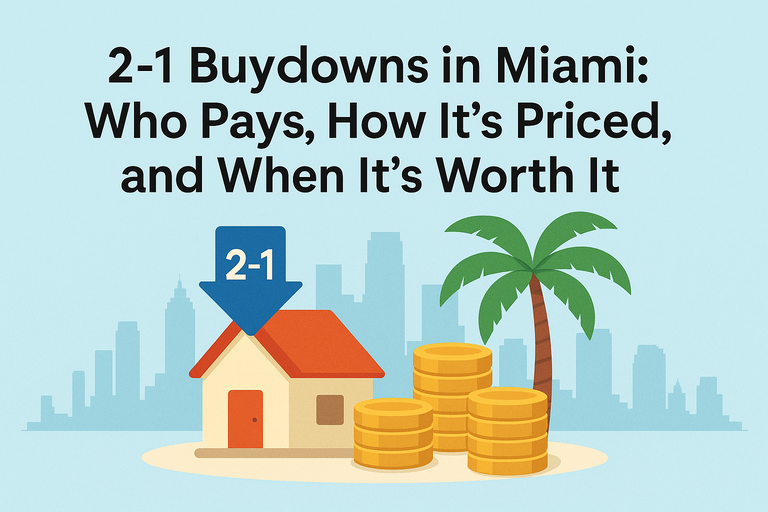
A 2-1 buydown is one of the most misunderstood tools in Miami real estate. People pitch it like “cheap money.” It’s not. It’s a temporary payment discount that somebody funds upfront—usually to help a buyer qualify or to make a high-rate market feel tolerable.
Used correctly, it’s smart. Used blindly, it’s an expensive band-aid.
What a 2-1 buydown actually does
A 2-1 buydown lowers your interest rate for the first two years:
- Year 1: rate is reduced by 2%
- Year 2: rate is reduced by 1%
- Year 3+: rate returns to the full note rate for the rest of the loan term
Example (conceptual):
- Note rate: 7.00%
- Year 1: 5.00%
- Year 2: 6.00%
- Year 3+: 7.00%
Important: this is not an adjustable-rate mortgage. The note rate is fixed; the payment is temporarily subsidized.
Who pays for the buydown?
Someone funds the temporary payment difference up front. Common sources:
1) Seller (most common in purchase deals)
Seller pays as a concession to make the deal close, especially when:
- the listing sits too long
- price cuts aren’t working
- buyer affordability is stretched
2) Builder (common in new construction)
Builders use buydowns to protect headline prices while still “helping” buyers.
3) Buyer (least ideal, but possible)
If you pay it yourself, you’re prepaying your own interest subsidy. That only makes sense in specific scenarios (more below).
How it’s priced (the part buyers never see)
A 2-1 buydown cost is based on the difference between the note-rate payment and the reduced-rate payment for Year 1 and Year 2.
Conceptually:
- Cost = (Monthly savings Year 1 × 12) + (Monthly savings Year 2 × 12)
That money is placed into a temporary buydown escrow account and applied monthly to reduce your payment during the first two years.
What this means in real life:
- Bigger loan amount = bigger buydown cost
- Higher note rate = bigger buydown cost
- The buydown isn’t “free”; it’s just prepaid subsidy
When a 2-1 buydown is worth it (and when it’s not)
Worth it when:
1) The seller pays, and you don’t overpay for the house
If you get a seller-paid buydown without inflating the purchase price, it can be a legit win.
2) You need short-term payment relief with a real plan
Examples of real plans:
- You’re starting a new job and income steps up in 6–18 months
- You’re relocating and expect bonus/commission ramp
- You’re renovating and expect to refinance after value-add (risky, but at least coherent)
If your plan is “rates will drop,” that’s not a plan. That’s a bet.
3) It helps you qualify (and you can still afford Year 3)
Some programs allow qualification using the reduced payment. But the real test is: can you handle the full payment once the subsidy ends?
If you can’t afford Year 3, you’re setting yourself up for payment shock.
Not worth it when:
1) You’re using it to ignore the true cost of the home
If you “afford” the house only with the Year 1 payment, you can’t afford the house.
2) You pay for the buydown but expect to sell/refi quickly
If you refinance early, unused buydown funds typically go to pay down principal or are handled per the program rules—not as cash back to you. You may not capture the value you thought you bought.
3) You could negotiate a price reduction instead
A permanent price cut reduces:
- your loan amount
- your payment for all years
- your taxes/insurance exposure (often)
A buydown is temporary. Price reduction is permanent.
The Miami negotiation angle: buydown vs price cut
Here’s a sharp way to think:
- If the seller has $X to “give,” ask:
Does $X reduce my lifetime cost more as a price cut or as a 2-1 buydown?
Often, a price reduction wins long-term. A buydown can win short-term affordability and qualification.
And yes—sometimes the best deal is both: small price reduction + smaller seller credit.
What to ask your lender/broker before you agree (non-negotiable)
- What is the note rate (Year 3+ rate) and APR?
- How much is the buydown cost, and who is paying it?
- Will I qualify on the reduced payment or the full payment?
- What happens to unused buydown funds if I refinance or sell early?
- Can I get the same seller credit as a price reduction, and what’s the payment difference?
If they can’t answer #4 clearly, you’re signing blind.
Bottom line
A 2-1 buydown is best when it’s seller-funded, you don’t overpay for the property, and you can comfortably afford the Year 3 payment. Anything else is a shiny trap.