Most Miami buyers obsess over the interest rate and ignore the pricing behind it. That’s how people accidentally overpay.
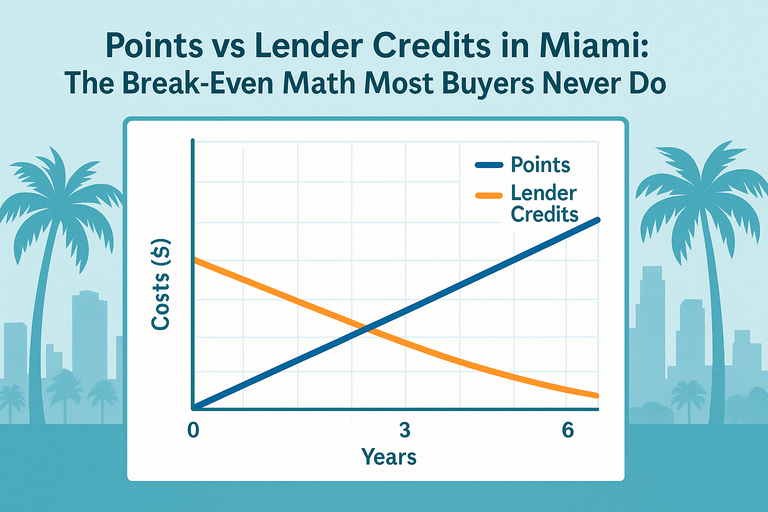
Here’s the clean truth: you’re always choosing between paying more upfront (discount points) to get a lower rate, or paying less upfront (lender credits) and accepting a higher rate. The smart move depends on one thing: how long you’ll keep the loan.
Definitions (no fluff)
Discount points: Upfront fee paid to lower your interest rate. Typically, 1 point = 1% of the loan amount (example: 1 point on a $500,000 loan = $5,000). The actual rate reduction per point varies by market.
Lender credits: The lender covers some of your closing costs in exchange for a higher interest rate. Great for cash-tight buyers. Bad for people who keep loans a long time.
The only formula that matters: break-even time
Step 1: Find the “extra cash” you’re paying upfront
This is the difference in total closing costs between the two options.
Example:
- Option A (lower rate): costs $6,000 more at closing (because you paid points)
- Option B (higher rate): costs $0 extra upfront (or even gives you credits)
So your extra upfront cost = $6,000
Step 2: Find monthly savings of the lower rate
Monthly savings = (monthly payment with higher rate) – (monthly payment with lower rate)
Example:
- Higher rate payment: $3,550
- Lower rate payment: $3,420
Monthly savings = $130
Step 3: Break-even months
Break-even = extra upfront cost ÷ monthly savings
= $6,000 ÷ $130 = 46.15 months
That’s about 3 years and 10 months.
If you’ll keep the loan longer than ~46 months, points likely win.
If you’ll refinance/sell sooner, credits likely win.
This is the math most people never do—and it’s why they lose.
Miami reality check: why break-even often gets shorter (or longer)
Points tend to make sense if:
- You’re buying a long-term primary residence
- You’re stable in Miami (not “maybe we move in 2 years”)
- You don’t expect refinancing soon
- You have strong cash reserves after closing
Lender credits tend to make sense if:
- You’re cash tight and need help closing
- You’re buying short-term (starter home, relocation, uncertain timeline)
- You believe you’ll refinance within 1–3 years
- You’re dealing with heavy Miami closing costs (insurance + escrow + HOA friction)
- https://mymiamimortgagebroker.com/rent-vs-buy-calculator-make-the-smartest-housing-decision/
The hidden traps people miss (read this twice)
Trap #1: “I’ll refinance soon anyway”
That’s not a plan. That’s a hope. Refinancing depends on:
- your income stability
- property value
- credit
- market rates being better
If rates don’t drop, you could be stuck with the higher-rate choice longer than you expected.
Trap #2: Points aren’t always fully recoverable
If you sell early, you don’t get “refunds” on points. You just paid extra for savings you never had time to realize.
Trap #3: Credits can mask expensive rates
Some lenders make offers look attractive by throwing credits at you while quietly charging a worse rate. You feel good at closing and bleed money monthly for years.
The practical way to choose (fast decision framework)
Pick points if:
- You expect to keep the mortgage 5+ years
- You have enough cash that paying points doesn’t wipe out reserves
- You want predictable long-term payment savings
Pick lender credits if:
- You expect to keep the mortgage under 3–4 years
- Cash-to-close is your biggest constraint
- You’re planning a likely refinance (and you accept the risk that it may not happen)
If your expected timeline is 3–5 years, don’t guess—run break-even using your lender’s exact numbers.
What to request from your lender/broker (non-negotiable)
Ask for a quote that shows at least 3 pricing options on the same day:
- Par rate (no points, minimal credits)
- Lower rate with points
- Higher rate with credits
Then compute break-even between #2 and #3. If they won’t provide side-by-side options, you’re not comparing—you’re being sold.
Bottom line
Points vs credits is not about “getting the best rate.” It’s about buying the cheapest loan for your timeline.