Florida’s rental market is thriving—from the beaches of Miami to the booming suburbs of Tampa and Orlando. Investors from across the country are buying income-generating properties to ride this wave. But to grow fast, they need financing that doesn’t slow them down.
Enter the DSCR loan—a favorite among real estate investors for its flexibility and ease of approval.
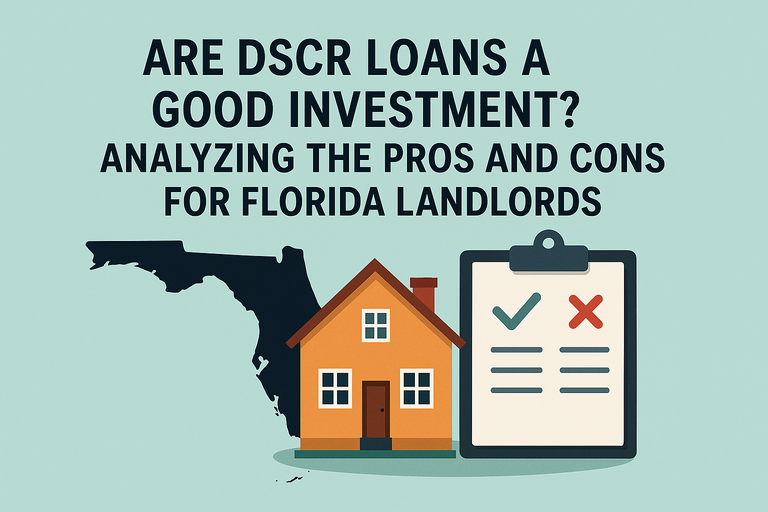
But are DSCR loans really a good investment strategy for landlords in Florida? Let’s unpack the pros, cons, and what you need to know before taking one on.
What Is a DSCR Loan?
A Debt Service Coverage Ratio (DSCR) loan is a type of mortgage designed specifically for income-producing properties.
Instead of qualifying you based on personal income, the lender looks at how well the property’s rental income covers its loan payments.
Here’s the formula:
[\text{DSCR} = \frac{\text{Net Operating Income (NOI)}}{\text{Annual Debt Payments}}]
For example, if a property generates $6,000 in annual net income and your loan payments are $5,000, your DSCR is 1.2.
Lenders typically want to see a DSCR of 1.0 to 1.25—meaning the property earns at least enough to pay for itself (and ideally a little more).
That makes these loans perfect for landlords looking to expand their portfolio without jumping through the usual income-verification hoops.
Why DSCR Loans Are Popular in Florida
Florida is a prime market for DSCR loans because:
- Rental demand is strong year-round, driven by tourism, population growth, and retirees.
- Many investors are self-employed or from out of state, making traditional loans harder to qualify for.
- The state’s no-income-tax advantage attracts high-net-worth individuals seeking to build rental portfolios.
Whether it’s a Miami condo, a Tampa duplex, or an Orlando Airbnb, DSCR loans make it easier for landlords to capitalize on these opportunities quickly.
The Pros: Why DSCR Loans Can Be a Good Investment
Let’s start with the reasons so many Florida investors choose DSCR financing.
1. No Personal Income Verification
You don’t need tax returns, pay stubs, or W-2s. Lenders only care about the property’s income potential, not your personal finances. That’s ideal for self-employed professionals or investors managing multiple properties.
2. Fast and Flexible Approval
Because underwriting focuses on property cash flow, DSCR loans usually close faster than traditional mortgages. This gives investors a competitive edge in hot markets like Miami, where good deals move fast.
3. Scalable Portfolio Growth
You can qualify for multiple DSCR loans because lenders assess each property on its own performance. That means you can keep expanding your portfolio without being limited by your personal debt-to-income ratio.
4. Perfect for LLC or Business Purchases
Many DSCR lenders allow borrowers to take loans under LLCs or corporations, helping separate personal and business assets for liability protection and tax advantages.
5. Ideal for Florida’s Short-Term Rental Market
For investors running Airbnbs or vacation rentals, DSCR loans are a game-changer. Lenders often consider short-term rental income (verified through platforms or appraisals), letting you leverage high nightly rates into long-term financing.
The Cons: What to Watch Out For
Of course, no loan product is perfect. DSCR loans come with trade-offs you should understand before diving in.
1. Higher Interest Rates
Since DSCR loans are considered riskier for lenders, interest rates are typically 1–2% higher than conventional mortgages. This can slightly reduce your cash flow if the rental income isn’t strong enough.
2. Larger Down Payments
Expect to put down 20–25%, sometimes more for riskier properties or short-term rentals. While this protects lenders, it ties up more of your capital upfront.
3. Strict Property Requirements
The property must generate consistent rental income. If it’s vacant, under renovation, or in a low-demand area, it may not qualify—or it could appraise lower than expected.
4. Limited to Investment Properties
You can’t live in a DSCR-financed property. It’s strictly for business use. For owner-occupied homes, you’ll need a conventional or Non-QM primary residence loan.
5. Prepayment Penalties
Many DSCR loans include prepayment penalties if you pay off the loan early (within 3–5 years). If you plan to refinance quickly, check your terms carefully.
When DSCR Loans Make the Most Sense
A DSCR loan can be an excellent investment strategy if:
- You’re a Florida landlord buying or refinancing rental properties.
- You have stable or projected rental income that comfortably exceeds expenses.
- You value speed, flexibility, and privacy over the absolute lowest rate.
- You plan to hold the property long-term rather than flip it quickly.
They’re especially powerful for investors with multiple rental units or those building a portfolio across Florida’s growing markets.
However, if your property is still being stabilized or you’re depending on appreciation rather than cash flow, a DSCR loan might not be the best fit.
Example: A Miami Investor’s Perspective
Imagine you’re buying a $500,000 Miami rental property projected to bring in $4,000 in monthly rent. After expenses, your net operating income is $3,000.
Your monthly loan payment is $2,400.
That’s a DSCR of 1.25—right where most lenders want it.
Even if your rate is slightly higher than a conventional mortgage, the fact that you didn’t need income verification and closed fast means you still came out ahead—especially in a market where timing is everything.
Final Verdict: Are DSCR Loans Good?
Yes—DSCR loans are good, but they’re not for everyone.
For Florida landlords and investors who value speed, scalability, and simplicity, DSCR loans can be a fantastic tool. They allow you to buy more properties, qualify faster, and build wealth through cash-flowing rentals.
But for homeowners or investors chasing the absolute lowest interest rates, traditional financing might be a better fit.
In the end, DSCR loans are best viewed as a strategic investment tool, not a one-size-fits-all solution.
If you’re serious about expanding your Florida rental portfolio, and your properties generate solid income, a DSCR loan could be the smartest way to grow—without letting paperwork slow you down.