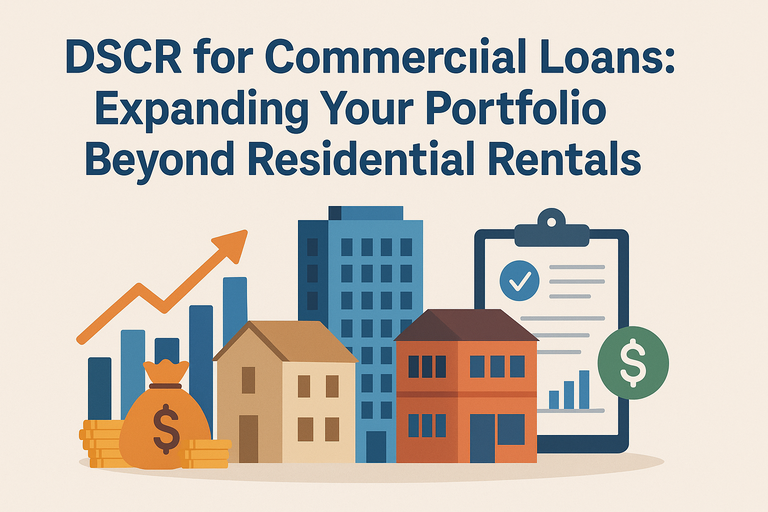
Real estate investors who’ve successfully built residential rental portfolios often contemplate expansion into commercial properties—retail spaces, office buildings, multi-family complexes, or mixed-use developments. This transition requires understanding how debt service coverage ratios work differently in commercial lending versus residential DSCR loans. Many investors ask: what is a DSCR for commercial loans, and how does this metric function when financing larger, more complex investment properties? Understanding commercial DSCR calculations, qualification standards, and strategic differences from residential DSCR loans prepares Florida investors for successful portfolio diversification beyond single-family rentals and small multi-family properties.
What is a DSCR for Commercial Loans?
What is a DSCR for commercial loans at its core? The Debt Service Coverage Ratio for commercial real estate measures the same fundamental relationship as residential DSCR—comparing property income against debt obligations—but with significantly more sophisticated analysis and stricter qualification standards.
Commercial DSCR Formula: DSCR = Net Operating Income (NOI) ÷ Annual Debt Service
The critical distinction is that commercial DSCR uses Net Operating Income (revenue minus operating expenses) rather than gross rental income used in residential DSCR calculations. This seemingly small difference creates dramatically different qualification dynamics and requires comprehensive property financial analysis.
Net Operating Income (NOI) Calculation
Commercial lenders scrutinize property financial performance through NOI:
NOI Formula: Gross Potential Income
- Vacancy Loss
- Credit Loss
- Other Income = Effective Gross Income
- Operating Expenses = Net Operating Income
Operating Expenses Include:
- Property management fees
- Property taxes
- Insurance (all types)
- Utilities (owner-paid)
- Repairs and maintenance
- Legal and accounting
- Marketing and advertising
- Property management
- HOA or CAM fees
- Janitorial and cleaning
- Security services
- CapEx reserves
Critical Exclusion: Mortgage payments (debt service) are NOT included in operating expenses.
Commercial DSCR Example
Tampa Mixed-Use Building:
- Gross annual income: $500,000
- Vacancy/credit loss (8%): -$40,000
- Effective gross income: $460,000
- Operating expenses: $180,000
- Net Operating Income: $280,000
- Annual debt service: $210,000 (mortgage payment)
- DSCR: $280,000 ÷ $210,000 = 1.33
This 1.33 DSCR indicates the property generates 33% more income than required for debt service after all operating expenses.
Commercial vs. Residential DSCR: Key Differences
Qualification Standards
Residential DSCR Loans (1-4 Units):
- Minimum DSCR: 1.0-1.25
- Uses gross rental income
- Operating expenses not deducted before calculation
- Personal credit heavily weighted
- 20-25% down payments typical
- 30-year terms common
Commercial DSCR Loans (5+ Units, Retail, Office, Industrial):
- Minimum DSCR: 1.20-1.35
- Uses Net Operating Income
- All operating expenses deducted before calculation
- Property performance primary factor
- 25-40% down payments typical
- 20-25 year terms common, often with balloon payments
Why Commercial DSCR Standards Are Stricter
Property Complexity: Commercial properties have more variable income streams, tenant turnover challenges, and maintenance uncertainties requiring larger cash flow cushions.
Tenant Concentration Risk: Single tenant vacancies in commercial properties can eliminate 20-50%+ of income, unlike residential properties with multiple smaller tenants.
Economic Sensitivity: Commercial real estate faces higher economic cycle sensitivity—office demand fluctuates with employment, retail struggles with e-commerce, requiring conservative DSCR ratios.
Longer Vacancy Periods: Commercial spaces take 6-18 months to re-lease versus 1-3 months for residential, demanding stronger cash flow coverage.
Capital Expenditure Requirements: Commercial properties require substantial periodic capital improvements (HVAC systems, roofs, parking lots) that operating expense reserves must cover.
Commercial DSCR Calculation Process
Understanding what is a DSCR for commercial loans requires examining lender underwriting:
Step 1: Income Analysis
Lenders review:
- Current rent rolls showing all tenants, lease rates, and expiration dates
- Historical income (3 years tax returns and financial statements)
- Market rent comparables for vacant spaces
- Lease structures (gross, net, triple-net)
- Tenant creditworthiness and lease terms
Florida Example – Miami Retail Center:
- Tenant A (40% of space): $120,000 annual, lease expires in 3 years
- Tenant B (35% of space): $90,000 annual, lease expires in 5 years
- Tenant C (25% of space): $60,000 annual, lease expires in 1 year
- Gross Income: $270,000
- Lease Risk: Tenant C lease expiration creates near-term re-leasing challenge
Step 2: Expense Analysis
Lenders scrutinize actual operating expenses versus market standards:
Underwriter Review:
- Property tax increases (Florida properties often see annual increases)
- Insurance trends (commercial insurance rising in Florida)
- Deferred maintenance needs
- Capital expenditure reserves (1-2% of gross income typically)
- Management efficiency
Adjustment Example:
- Owner claims $80,000 annual operating expenses
- Lender reviews comparables showing market average: $95,000
- Lender uses: $95,000 (higher, more conservative figure)
- Impact: Reduces NOI by $15,000, lowering DSCR
Step 3: DSCR Calculation
Using stabilized NOI (adjusted for market conditions and normalized expenses):
Jacksonville Office Building:
- Stabilized NOI: $350,000
- Proposed loan: $2.5 million at 7.5%, 25-year amortization
- Annual debt service: $261,600
- DSCR: $350,000 ÷ $261,600 = 1.34
- Lender Assessment: Acceptable (exceeds 1.25 minimum)
Commercial Property Types and DSCR Requirements
Multi-Family (5+ Units)
Typical DSCR Requirements: 1.20-1.30 minimum
Florida Markets: Tampa and Orlando multi-family properties with strong occupancy and diverse tenant base achieve competitive financing.
Advantage: Multiple income streams reduce vacancy impact; residential demand relatively stable.
Retail Properties
Typical DSCR Requirements: 1.25-1.35 minimum
Higher Requirements Because:
- E-commerce pressures on retail demand
- Tenant turnover challenges
- Economic sensitivity
Florida Opportunity: Tourist-area retail in Miami Beach, Key West, or Orlando maintains strong performance justifying commercial DSCR financing.
Office Buildings
Typical DSCR Requirements: 1.30-1.40 minimum
Stricter Standards Due To:
- Work-from-home impacts on demand
- Long lease-up periods for vacant spaces
- Tenant creditworthiness critical
Florida Markets: Medical office, government-tenant office, or professional services office in growing markets like Tampa and Fort Myers offer stable income.
Industrial/Warehouse
Typical DSCR Requirements: 1.25-1.35 minimum
Favorable Characteristics:
- E-commerce driving warehouse demand
- Longer lease terms common
- Lower tenant improvement costs
Florida Growth: Distribution facilities near ports (Miami, Jacksonville) and logistics hubs benefit from strong e-commerce trends.
Mixed-Use Properties
Typical DSCR Requirements: 1.30-1.40 minimum
Complexity Factors:
- Multiple property types increase risk
- Different tenant types require varied management
- Residential and commercial components assessed separately
Florida Application: Urban mixed-use in Miami, Tampa, or St. Petersburg with ground-floor retail and upper-floor residential requires sophisticated underwriting.
Loan Terms for Commercial DSCR Financing
Amortization and Terms
Common Structures:
- 20-25 year amortization (vs. 30 years residential)
- 5, 7, or 10-year balloon payments (full balance due, requires refinancing)
- Interest-only periods less common than residential DSCR
Example:
- Loan amount: $3 million
- Amortization: 25 years
- Balloon: 10 years
- At year 10: $2.1 million balance due
Florida Strategy: Strong appreciation markets may justify balloons, planning refinancing or sales before maturity.
Interest Rates
Commercial DSCR Rates: Typically 1-2% higher than residential DSCR rates (8-11% current market)
Rate Factors:
- Property type (multi-family best, office highest)
- DSCR strength (1.35+ achieves better rates)
- Loan size (larger loans sometimes get better rates)
- Geographic market stability
- Property condition and age
Down Payment Requirements
Typical Commercial: 30-40% down payment (60-70% LTV maximum)
Conservative Lending: Higher down payments reflect greater commercial property risk and provide larger equity cushions.
Transitioning from Residential to Commercial DSCR
Building Qualifications
Experience Requirements: Many commercial lenders require:
- 5+ years residential investment experience
- Successfully managing 5-10+ properties
- Demonstrated property management competence
- Strong financial reserves
Financial Capacity:
- Substantial liquidity (6-12 months full property operating expenses)
- Strong personal credit (680-700+ minimums)
- Proven ability to manage complex properties
Strategic Approach
Step 1: Master residential DSCR investing (1-4 units) building track record
Step 2: Progress to small multi-family (5-10 units) using commercial DSCR loans
Step 3: Expand to larger multi-family or diversified commercial properties
Step 4: Consider portfolio commercial loans consolidating multiple properties
Florida-Specific Opportunities
Growing Markets: Tampa, Orlando, Jacksonville, and Fort Myers offer commercial opportunities with population growth driving demand.
Tourism Properties: South Florida commercial properties serving tourist markets (hotels converted to mixed-use, retail near attractions) provide specialized opportunities.
Emerging Neighborhoods: Gentrifying areas in Miami, Tampa, and Jacksonville offer mixed-use development opportunities with strong upside potential.
Understanding What is a DSCR for Commercial Loans: Strategic Summary
What is a DSCR for commercial loans encompasses sophisticated analysis of Net Operating Income against debt obligations, requiring comprehensive property financial understanding and stricter qualification standards than residential DSCR lending. Key distinctions:
Calculation: Uses NOI (after all operating expenses) versus gross income Standards: Requires 1.20-1.35+ DSCR versus 1.0-1.25 residential Terms: Typically 20-25 year amortizations with balloons versus 30-year fully amortizing Down Payments: 30-40% versus 20-25% residential Complexity: Extensive property financial analysis versus simplified residential evaluation
Florida investors successfully transitioning from residential to commercial DSCR financing position themselves for:
- Larger individual property returns
- Portfolio diversification across property types
- Sophisticated wealth-building strategies
- Professional investor status
The path from residential rentals to commercial properties through progressive DSCR loan experience creates sustainable portfolio growth while building expertise necessary for successfully managing complex commercial investments.
Ready to explore commercial DSCR financing for expanding your Florida investment portfolio beyond residential properties? Connect with commercial mortgage professionals who understand both residential DSCR lending and commercial property financing, helping structure your transition to larger, more sophisticated investments that leverage your proven residential investment success.