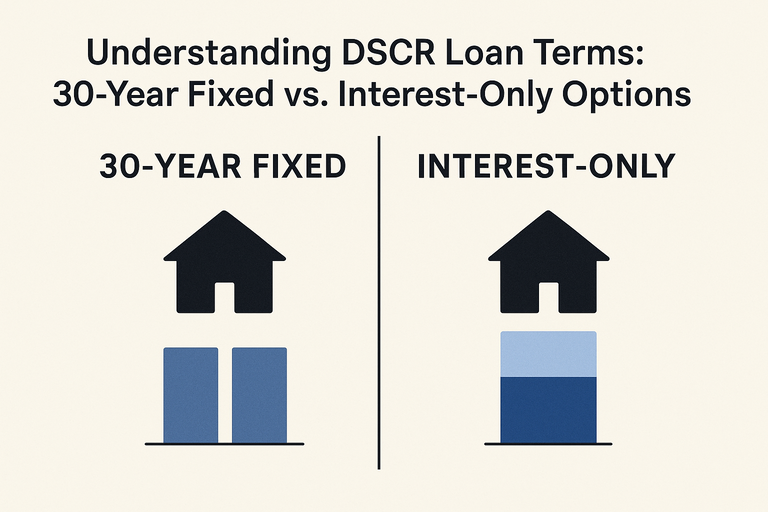
Selecting the right loan term significantly impacts real estate investment success, affecting monthly cash flow, equity building velocity, and long-term wealth accumulation strategies. Many investors exploring DSCR financing ask fundamental questions: can you do a 30 year DSCR loan, are DSCR loans interest only, and how long are DSCR loans typically? Understanding available term structures, their strategic applications, and trade-offs empowers Florida investors to optimize financing decisions based on property performance characteristics and investment goals.
Can You Do a 30 Year DSCR Loan?
Absolutely—can you do a 30 year DSCR loan receives an enthusiastic yes. The 30-year fixed-rate term represents the most popular structure among DSCR borrowers, mirroring conventional mortgage preferences. This term provides the lowest possible monthly payments by spreading principal repayment across three decades, maximizing initial cash flow for investment properties.
Why 30-Year Terms Dominate DSCR Lending
Cash Flow Optimization: Lower monthly payments compared to shorter terms directly translate to stronger monthly cash flow, the lifeblood of rental property investing.
DSCR Qualification: Since DSCR ratios compare rental income to debt service, lower monthly payments from 30-year amortization help properties qualify more easily. A property with marginal cash flow might achieve 1.15 DSCR with 30-year terms but only 0.95 with 20-year terms.
Portfolio Scalability: Lower payments enable investors to qualify for additional properties more quickly as cash flow accumulates faster with minimal debt service.
Risk Management: Extended amortization provides payment cushions during vacancy periods, major repairs, or economic downturns affecting rental demand.
30-Year DSCR Loan Example
Tampa Single-Family Rental:
- Purchase price: $350,000
- Down payment: 25% ($87,500)
- Loan amount: $262,500
- Interest rate: 7.5%
- 30-year payment: $1,835/month (P&I)
- 20-year payment: $2,115/month (P&I)
- Monthly cash flow difference: $280
For an investor targeting $2,400 monthly rental income, the 30-year term provides significantly stronger DSCR ratio and cash flow compared to shorter amortization periods.
How Long Are DSCR Loans? Available Term Options
Understanding how long are DSCR loans requires examining the full spectrum of available terms. While 30 years dominates, DSCR lenders offer various amortization periods accommodating different investment strategies:
Standard Fully Amortizing Terms
30-Year Terms: Most common; maximum cash flow, slowest equity building through principal payments. Ideal for buy-and-hold investors prioritizing monthly income.
25-Year Terms: Slightly lower interest rates (0.125-0.25% reduction) offset by higher payments. Modest equity building acceleration. Suitable for investors balancing cash flow with wealth accumulation.
20-Year Terms: Lower rates, significantly higher payments, substantial equity building. Best for investors with strong cash flow properties who prioritize debt reduction.
15-Year Terms: Lowest rates available (typically 0.5-0.75% below 30-year rates), dramatically higher payments. Rarely used for investment properties except with exceptional cash flow or specific rapid equity-building strategies.
Balloon Payment Terms
Some DSCR lenders offer balloon payment structures:
30-Year Amortization with 7-10 Year Balloons: Payments calculated on 30-year amortization but full balance due after 7-10 years. Requires refinancing or property sale at balloon maturity.
Advantages: Sometimes offer slightly lower rates; forces strategic reevaluation at balloon maturity.
Risks: Refinancing uncertainty if property values decline or lending criteria tighten; potential forced sale in unfavorable markets.
Application: Works for investors confident in appreciation or planning disposition within balloon period.
Florida Market Considerations
How long are DSCR loans should factor Florida-specific dynamics:
Strong Appreciation Markets: Miami, Tampa, and coastal areas with robust appreciation may justify shorter terms or balloons given equity building through market value increases.
Cash Flow Markets: Jacksonville and emerging markets with lower appreciation but strong rent-to-price ratios favor 30-year terms maximizing monthly income.
Hurricane Risk: Extended terms provide payment cushions for hurricane-related insurance increases or repair costs between major storms.
Are DSCR Loans Interest Only?
The question “are DSCR loans interest only” requires nuanced understanding—DSCR loans can include interest-only periods but aren’t exclusively interest-only products.
Interest-Only DSCR Loan Structures
Many DSCR lenders offer hybrid structures combining initial interest-only periods with subsequent fully amortizing periods:
Common Structures:
- 10/20: 10 years interest-only, then 20 years fully amortizing
- 7/23: 7 years interest-only, then 23 years fully amortizing
- 5/25: 5 years interest-only, then 25 years fully amortizing
During interest-only periods, payments cover only interest—no principal reduction. After the interest-only period expires, payments jump substantially as both principal and interest amortize over the remaining term.
Interest-Only Payment Example
Orlando Vacation Rental – $400,000 Loan at 7.75%:
Interest-Only Period (Years 1-10):
- Monthly payment: $2,583 (interest only)
- Principal balance: Remains $400,000
- Annual equity building: $0 from payments (only from appreciation)
Amortizing Period (Years 11-30):
- Monthly payment: $2,970 (P&I amortized over 20 years)
- Payment increase: $387/month (15% jump)
- Principal reduction begins
Comparison to 30-Year Fully Amortizing:
- 30-year amortizing payment: $2,797/month
- Interest-only savings: $214/month during first 10 years
- Total interest-only savings over 10 years: $25,680
Strategic Applications of Interest-Only Terms
Maximum Initial Cash Flow: Properties with strong appreciation potential but tight initial cash margins benefit from reduced payments during early ownership.
Value-Add Properties: Investors planning renovations use interest-only payments to preserve capital for improvements, then refinance after value increases.
Portfolio Expansion: Deploying monthly savings from interest-only payments as down payments on additional properties accelerates portfolio growth.
Short-Term Holds: Properties planned for sale within 5-10 years benefit from lower payments without concern for principal reduction.
Tax Strategy: Maximizing interest deductions during high-income years while deferring principal payments to later periods.
Interest-Only Risks and Considerations
Payment Shock: 15-30% payment increases when amortization begins can create cash flow challenges if rental income hasn’t increased proportionally.
No Equity Building: Interest-only periods build equity only through appreciation, not principal reduction. Market stagnation or decline leaves investors with no equity cushion.
Higher Total Interest: Interest-only structures cost substantially more over loan life compared to fully amortizing terms.
Refinancing Pressure: Many investors planning to refinance before amortization periods discover changed market conditions, health issues, or tightened lending standards prevent refinancing.
Lender Requirements: Interest-only DSCR loans typically require:
- Higher credit scores (700+ often required)
- Larger down payments (25-30%)
- Stronger DSCR ratios (1.25+ typically)
- Significant reserves (12+ months)
- Slightly higher interest rates (0.25-0.5% premium)
Who Should Avoid Interest-Only Terms?
Conservative Investors: Those prioritizing stability and guaranteed equity building through principal reduction.
Retirement-Focused Strategies: Investors seeking debt-free properties by retirement need amortizing loans.
First-Time Investors: Inexperienced investors benefit from forced savings through principal payments.
Marginal Cash Flow Properties: Properties barely achieving qualifying DSCR ratios can’t absorb payment increases when amortization begins.
Comparing Term Structures: Strategic Decision Framework
30-Year Fully Amortizing: Best For
- Long-term buy-and-hold investors (10+ years)
- Properties with moderate cash flow margins
- Conservative risk tolerance
- First-time investment property owners
- Portfolio scalability focused on acquiring multiple properties
- Stable monthly income prioritization
Example: Jacksonville rental generating $2,200 monthly with moderate appreciation prospects.
Interest-Only (10/20 or 7/23): Best For
- Properties with strong appreciation potential
- Value-add renovation strategies
- Experienced investors with proven exit strategies
- High-income periods maximizing tax deductions
- Short-to-medium term holds (5-10 years)
- Aggressive portfolio expansion strategies
Example: Miami Beach condo purchased below market, planned for 7-year appreciation before sale or refinance.
20-Year or 25-Year Amortizing: Best For
- Strong cash flow properties absorbing higher payments
- Moderate wealth-building acceleration
- Investors 10-15 years from retirement targeting paid-off properties
- Properties in markets with modest appreciation expectations
- Balance between cash flow and equity building
Example: Tampa duplex with $4,500 combined rental income supporting higher payments while building equity faster.
Florida Investment Property Term Selection
How long are DSCR loans should reflect Florida’s unique investment landscape:
Miami/South Beach: High appreciation potential justifies interest-only or shorter terms capturing equity gains through market value increases.
Tampa/St. Petersburg: Balanced markets favor 30-year terms providing cash flow stability with steady appreciation.
Jacksonville/Emerging Markets: Cash flow focus with moderate appreciation makes 30-year terms optimal for monthly income generation.
Vacation Rentals (Orlando, Keys, coastal areas): Seasonal income volatility benefits from 30-year or interest-only terms minimizing payment obligations during slower periods.
Multi-Family (2-4 units): Strong cash flow from multiple units supports 25-year or 20-year terms accelerating equity building.
The Strategic Verdict
Can you do a 30 year DSCR loan? Yes—and it’s the most popular term structure providing maximum cash flow optimization. Are DSCR loans interest only? They can be, with many lenders offering hybrid structures combining interest-only periods with subsequent amortization. How long are DSCR loans? Terms range from 15 to 30 years, with various structures accommodating diverse investment strategies.
Decision Framework:
- Conservative/Long-term: 30-year fully amortizing
- Aggressive/Appreciation-focused: Interest-only hybrids
- Balanced/Moderate: 25-year amortizing
- Equity-building/Pre-retirement: 20-year amortizing
The optimal term structure aligns with property characteristics, market conditions, investment timeline, and personal financial goals. Many sophisticated Florida investors use different terms across portfolios—30-year for stable cash flow properties, interest-only for high-appreciation plays, and shorter terms for strong-performing assets.
Ready to explore various DSCR loan term structures for your Florida investment properties? Connect with mortgage professionals who can model different scenarios, compare monthly payments and total costs, and recommend optimal terms based on your specific properties and investment strategy.